
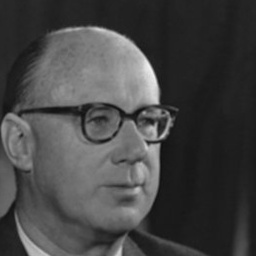
British colonial administrator
John James Cowperthwaite Quotes: 21 Famous Sayings
By the Quotlr.com Team
John James Cowperthwaite was a British colonial administrator who served in Hong Kong from 1945 to 1971. He is credited with implementing a policy of laissez-faire economics in the city, which helped to make it one of the most prosperous cities in the world. His policies focused on minimal government intervention and free markets, leading to Hong Kong's rapid economic growth.
- Born
- April 25, 1915
- Died
- January 21, 2006
- Known as
- British
6 quotes
Top 10 John James Cowperthwaite Quotes
-
1.
A glimmer of light is better than no illumination at all.
-
2.
I would suggest to my honourable Friend that the foreign investor is at least as discouraged by high national debt for that, as all example shows, is the surest precursor of high taxation.
-
3.
Revenue has increased in this way is in no small measure, I am convinced, due to our low tax policy which has helped to generate an economic expansion in the face of unfavourable circumstances.
-
4.
Money cannot be converted into houses or trained teachers or hospitals at the touch of a magic wand. There are limitations to our physical and intellectual resources.
-
5.
One trouble is that when Government gets into a business it tends to make it uneconomic for anyone else.
- Advertisement
-
6.
I am confident, however old-fashioned this may sound, that funds left in the hands of the public will come into the Exchequer with interest at the time in the future when we need them.
15 quotes
John James Cowperthwaite Famous Quotes And Sayings
-
If people want consultative government, the price is increased complexity and delay in arriving at decisions. If they want speed of government, then they must accept a greater degree of authoritarianism. I suspect that the real answer is that most people prefer the latter so long, that is, as government's decisions conform with their own views.
-
I largely agree with those that hold that Government should not in general interfere with the course of the economy merely on the strength of its own commercial judgment. If we cannot rely on the judgment of individual businessmen, taking their own risks, we have no future anyway.
-
I am afraid that I do not believe that any body of men can have enough knowledge of the past, the present and the future to establish "development priorities" - which presumably means procuring some developments as being good and prohibiting others as being bad.
-
I am also, I must confess, a little sceptical of the theory that we have a right, if we could, to pass on our capital burden to future generations. I remarked last year in this context that our predecessors had not passed any significant part of their burden on to us.
-
The fact that previous generations have handed down to us a substantial public heritage by way of roads, port, etc. almost completely free of debt, seems to me to impose some limitation on the validity of the theory that by borrowing we should, or could, pass on the burden of development to the next generation.
-
What gives me concern in so much of the comment is the implication that the people of Hong Kong have to be given a reward, like children, for being good last year, and bribed, like children, into being good next year. I myself repudiate this paternalistic, indeed colonialist, attitude as a gross insult to our people.
-
I hold that two principles are important; first that there should be a steady expansion of public services, not an irregular one related to revenue accruing in any particular year; the second that taxes should be constant over long periods (provided, that is, that they are neither burdensome nor inequitable).
-
Deficit financing proper is rather the process whereby a Government spends more money that it withdraws from the economy by taxation, borrowing, running down reserves, etc.; thereby causing in most circumstances, and very acutely in ours, monetary inflation and severe pressure on the balance of payments.
-
My own views on all matters of public revenue and public expenditure are conditioned by an acute appreciation of whose is the sacrifice that produces public revenue and to whom accrues the benefit of public spending.
-
I still believe that, in the long run, the aggregate of the decisions of individual businessmen, exercising individual judgment in a free economy, even if often mistaken, is likely to do less harm than the centralized decisions of a Government; and certainly the harm is likely to be counteracted faster. As I said earlier in this debate, our economic medicine may be painful but it is fast and powerful because it can act freely.
-
I should like to begin with a philosophical comment. I do not think that when one is speaking of hardships or benefits one can reasonably speak in terms of classes or social groups but only in terms of individuals.
- Advertisement
-
We enjoy a considerable net inflow of capital and I am sure that a condition of its coming, and staying, is that it is free to flow out again. It is also important for Hong Kong's status as a financial centre that there should be a maximum freedom of capital movement both in and out.
-
Over a wide field of our economy it is still the better course to rely on the nineteenth century's "hidden hand" than to thrust clumsy bureaucratic fingers into its sensitive mechanism. In particular, we cannot afford to damage its mainspring, freedom of competitive enterprise.
-
Official opposition to overall economic planning and planning controls has been characterized in a recent editorial as "Papa knows best." But it is precisely because Papa does not know best that I believe that Government should not presume to tell any businessman or industrialist what he should or should not do, far less what he may or not do; and no matter how it may be dressed up that is what planning is.
-
I must confess my distaste for any proposal to use public funds for the support of selected, and thereby, privileged, industrialists, the more particularly if this is to be based on bureaucratic views of what is good and what is bad by way of industrial development, but I have been studying the report referred to with some interest.
Life Lessons by John James Cowperthwaite
- John James Cowperthwaite's work in Hong Kong showed that economic freedom and minimal government intervention can lead to economic growth and prosperity.
- His policies of low taxation, free trade, and minimal government intervention allowed Hong Kong to become one of the wealthiest cities in the world.
- His work serves as an example of how economic freedom and limited government involvement can lead to economic success and growth.