
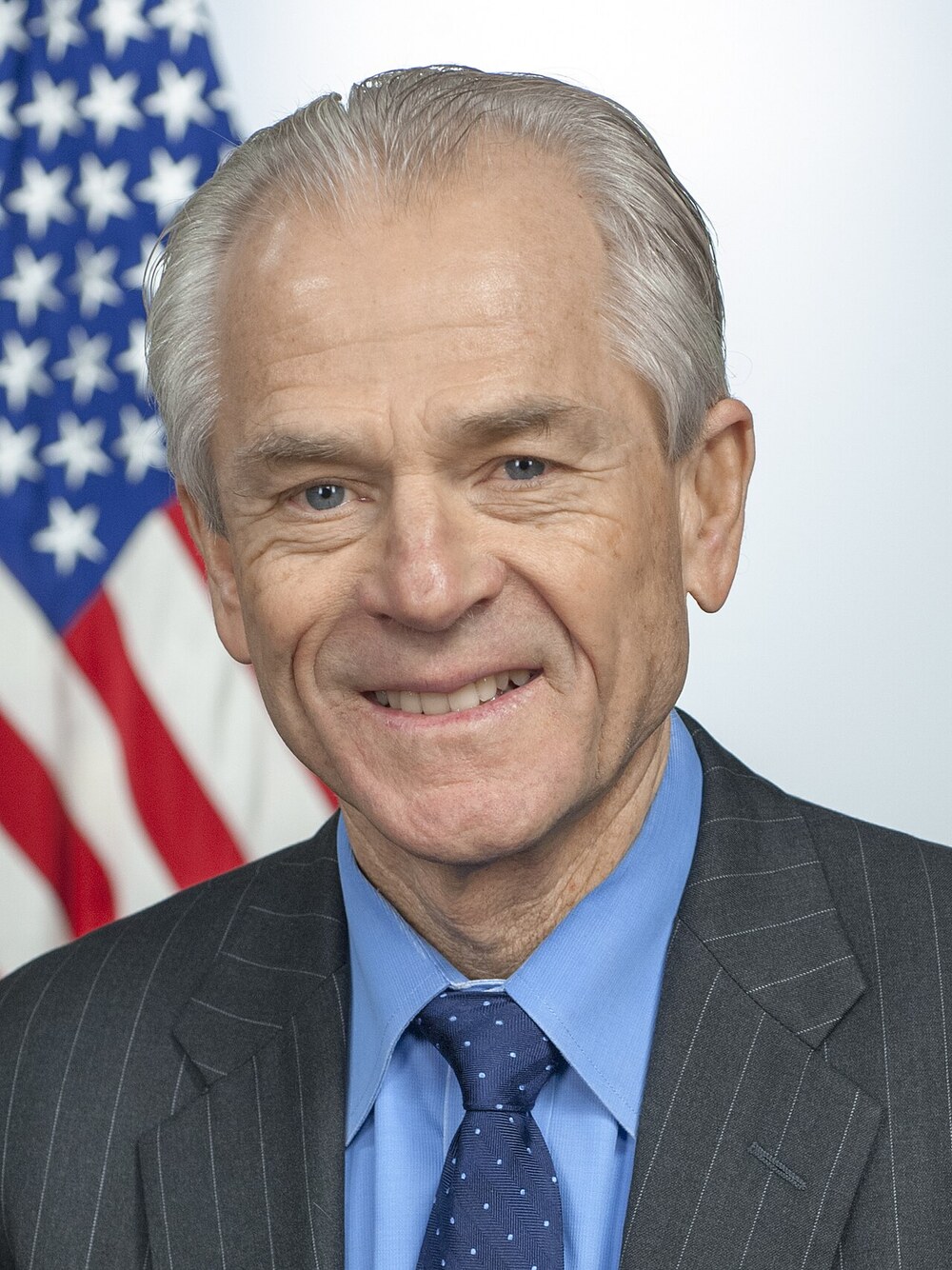
American economist and author, Trump advisor
Peter Navarro Quotes: 16 Sayings on Education and Politics
By the Quotlr.com Team
Peter Navarro is an American professor of economics and public policy. He is currently a professor at the University of California, Irvine, and a director of the university's Economic Policy Research Institute. He is best known for his books on international economics, trade, and China-U.S. relations. Following is our collection on famous quotes by Peter Navarro on education, politics, war.
- Born
- January 20, 1971
- Died
- October 17, 2014
- Known as
- American Professor
-
No one should be surprised just because somebody isn't successful 100 percent of the time.
-
When we run these big trade deficits and send our jobs offshore, we hold our wages down and our income down. That feeds right back into the biggest part of this whole equation, consumption. This drags GDP down as well.
-
This is what Donald Trump understands. This is the trade deficit. We run a trade deficit of close to $800 billion a year.
-
The Donald Trump trade doctrine is this. America will trade with any country, so long as that deal meets these three criterion: You increase the GDP growth rate, you decrease the trade deficit, and you strengthen the manufacturing base.
-
Unfair trade practices drive up rents for younger people. They will drive up home prices for first-time home-buyers. So it's not just that we're losing jobs and factories. We're giving away our homes, our businesses, our companies, our technologies.
- Advertisement
-
We're going right down the toilet, and it's a made-in-China toilet. I teach MBAs. And I noticed, starting a few years after China joined the World Trade Organization, that a lot of my students were no longer employed. They were still coming to get their MBA, but they'd lost their jobs.
-
Donald Trump is not a protectionist. If he imposes tariffs on China or any other country that cheats, all he wants to do is defend America against unfair trade practices.
-
China are running trade deficits with the rest of the world. If you look at the U.S. trade deficit, it's close to $800 billion trade in goods. Half of that is with China, so it's a big part of the problem. And the problem with China, as opposed to, say, Canada, is that China cheats.
-
The policy goal is to persuade China to stop cheating. But here's what's interesting - Donald Trump intuitively understands what things should be. I did a study in 2008 where I estimated the impact of China's unfair trade practices on their competitive advantage - the so-called China Price. You know what it came out to be? Forty-three percent. Forty-three percent - very close to what his intuition said we needed in order to equalize things.
-
Donald Trump understands China influence. He's been talking about it since 1980. He understands it. The people that are on the other side of this, including his opponent, Hillary Clinton, have been part of every bad trade negotiation we've had since 1993.
-
As soon as one bad actor like China massively cheats, they win at the expense of us; they win at the expense of Europe and over time it threatens the entire integrity of the global financial system and the global trading system.
-
If you've been to China, you know there are over 100 cities in China, and the pollution levels are just horrific - 60,000 people a year die in Chinese factories and facilities, because they don't have any safety regulations. It's a carnage; it's Dickensian.
-
The really big problem with China is that there are the unfair trade practices, like currency manipulation, illegal export subsidies and the theft of intellectual property, but then there's also things that the WTO doesn't cover that it should, which is the use of sweat shops and pollution havens.
-
When China got into the WTO, that allowed it to sell into any other country within the WTO - not just the United States - at the lowest tariffs that country offered. And the other countries could sell into China at the lowest tariffs that China offered. The problem, right off the bat, was that China had much higher tariffs than everywhere else, so the U.S. and Europe in particular got the short end of that stick.
-
From 1947 to 2001, the American economy grew annually at a rate of 3.5 percent. After China got into the World Trade Organization, got access to our markets and flooded our markets with its illegally subsidized exports, we grew at a rate of 1.8 percent from 2002 to 2015. That's almost cut in half.
-
The defining moment in American economic history is when Bill Clinton lobbied to get China into the World Trade Organization. It was the worst political and economic mistake in American history in the last 100 years.
Life Lessons by Peter Navarro
- Peter Navarro's work emphasizes the importance of taking a holistic approach to economic policy, with an emphasis on the interconnectedness of global markets.
- He has also highlighted the need for governments to be proactive in addressing economic issues, rather than simply reacting to them.
- He has also stressed the importance of understanding the potential impacts of trade agreements and other economic policies on different countries and regions.
Cite this page · Portrait: White House under the Donald Trump administration, Public domain, via Wikimedia Commons
