
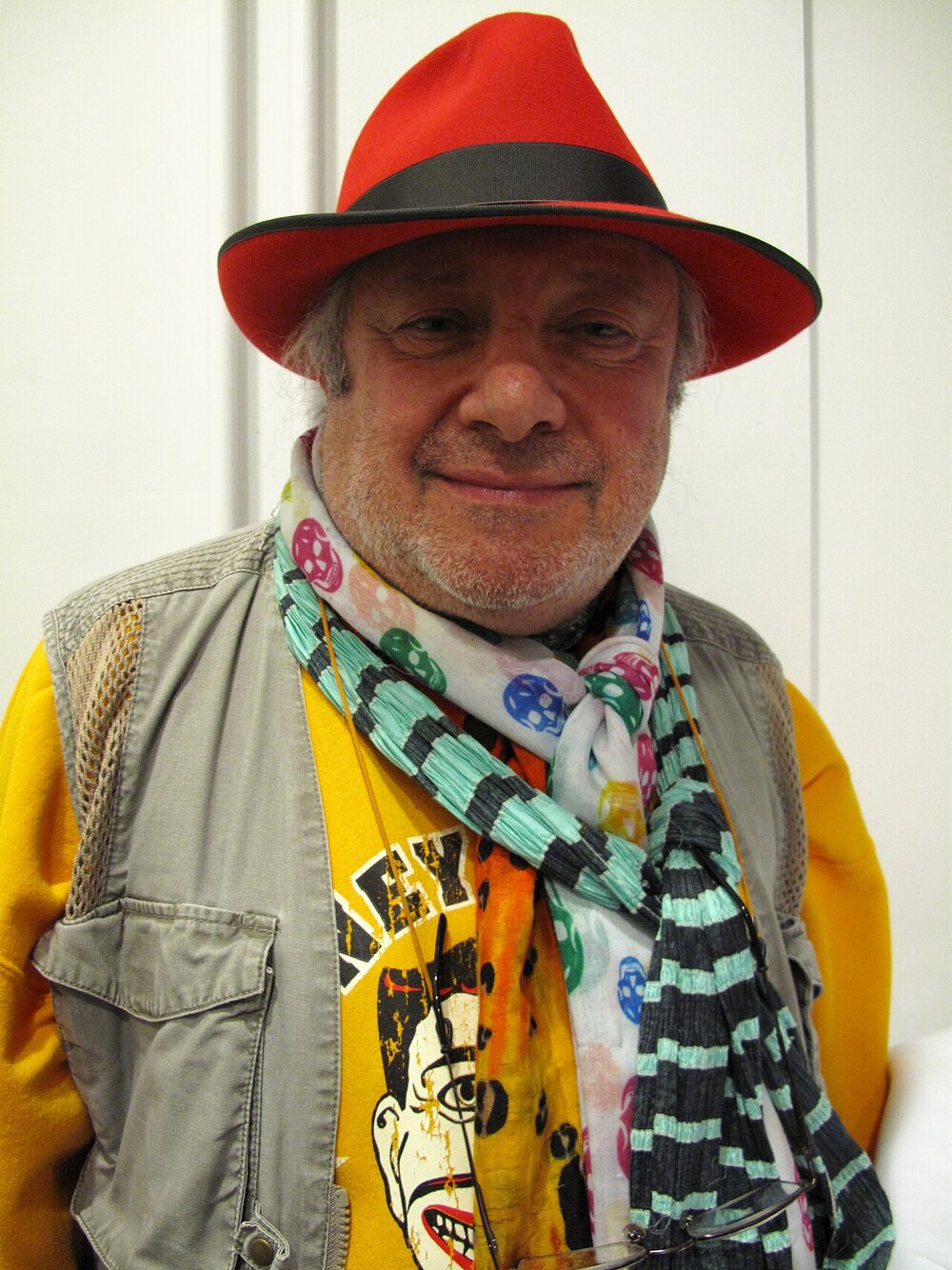
American visual artist and musician
Charlemagne Palestine Quotes: 17 Sayings on War
By the Quotlr.com Team
Charlemagne Palestine is an American composer, performer, and visual artist. He is known for his pioneering work in drone music, minimalism, and ritualistic performance. He has composed works for a variety of instruments, including carillon, organ, and synthesizer, and is also a vocalist and improviser. Following is our collection on famous quotes by Charlemagne Palestine on war, education, death.
- Born
- August 15, 1945
- Known as
- American Composer
-
There are pieces that in the history of music that also make me cry. I'm not ashamed to cry.
-
I don't like the piano player music of the movies, the Michael Nyman, and sometimes that piano music makes me puke. It's not really romantic. It's just trying to get your Pavlovian juices flowing because it's a technique now.
-
I'm not afraid to be a Russian Jewish romantic in my approach to anything, even in my animal divinities, or anything about the feeling.
-
For Jewish people, salmon has a special meaning, not just because it's a flavor we've had all along our diaspora. Salmon also have this special return-to-their-roots desire. At the end of their lives, salmon try to swim back to when they were born. Even if they can't, they have this obsession. We as diaspora people love that a lot about salmon.
-
I played to 20,000 people every day because people were walking on 5th Ave going to and from their jobs, and my sounds were bathing them in all kinds of dissonance, consonance, resonance, and things like that.
- Advertisement
-
People never heard bells in Western music sounding really cataclysmic. You hear that more in Russian music or in Asian, Indonesian traditions.
-
I had already been a young singer. And once, as a profession, I was a young singer, what you would call a soprano in England, but I was an alto in singing Jewish music in bar mitzvahs and weddings and synagogues throughout New York City because, after Israel, New York is probably the biggest Jewish community in the world.
-
My music education was oral. I was resistant to scores and things like that. In Jewish religious music, there are no scores. You learn everything by rote, by ear, by repeating.
-
I found so much fun in the light shows and the multimedia shows of the hippies. That was when I was a student in the 1960s, and I was in New York, so I learned how to deal with writing, recording sound of other people, performance art - because that was a new territory, and I liked everything that was new and provocative. That interested me more than becoming anything specific.
-
I never made any money from my music. I don't make that much; I make it flip-flopping between five and ten different disciplines.
-
I hung around hippie-ish kind of people and, first of all, they never made any money. If you never make any money, you never have to declare any profession!
-
There are some people who love being a something, but I also got the gist in the 60's when I grew up that you could be, in the art scene, very diverse.
-
Not that I have anything against music now, but I just hated being an anything. I don't know why.
-
I actually started as a singer in Brooklyn, and I lived in a community. To get out of the ghetto of my community, I was a musician.
-
I never wanted to have a profession, and I've succeeded in not having one, or if I did have one it never paid, or it's never been especially long-term.
-
I never became primarily a musician! I've always been a wanderer and I'm always bored.
-
around 1977 I became very ... negative, I began to do things unconsciously that I didn't understand, and they were very sabotagistic and I didn't know what I was doing. I was pissing everybody off, I was breaking my bridges. I was hostile to people, I was doing performances and insulting people there - I was doing whatever I could to destroy whatever world I had created ten years before, without knowing, really, why
- Advertisement
Life Lessons by Charlemagne Palestine
- Charlemagne Palestine's work emphasizes the importance of experimentation and improvisation in composition, encouraging listeners to explore the potential of music and sound.
- His unique approach to composition, which often involves the use of drones, repetition, and layering, encourages listeners to appreciate the beauty of sound in its simplest forms.
- By combining elements of minimalism, avant-garde, and musique concrète, Palestine's work serves as a reminder of the power of music to evoke emotion and create a sense of atmosphere.
Cite this page · Portrait: Sandra Fauconnier, CC BY-SA 3.0, via Wikimedia Commons
