
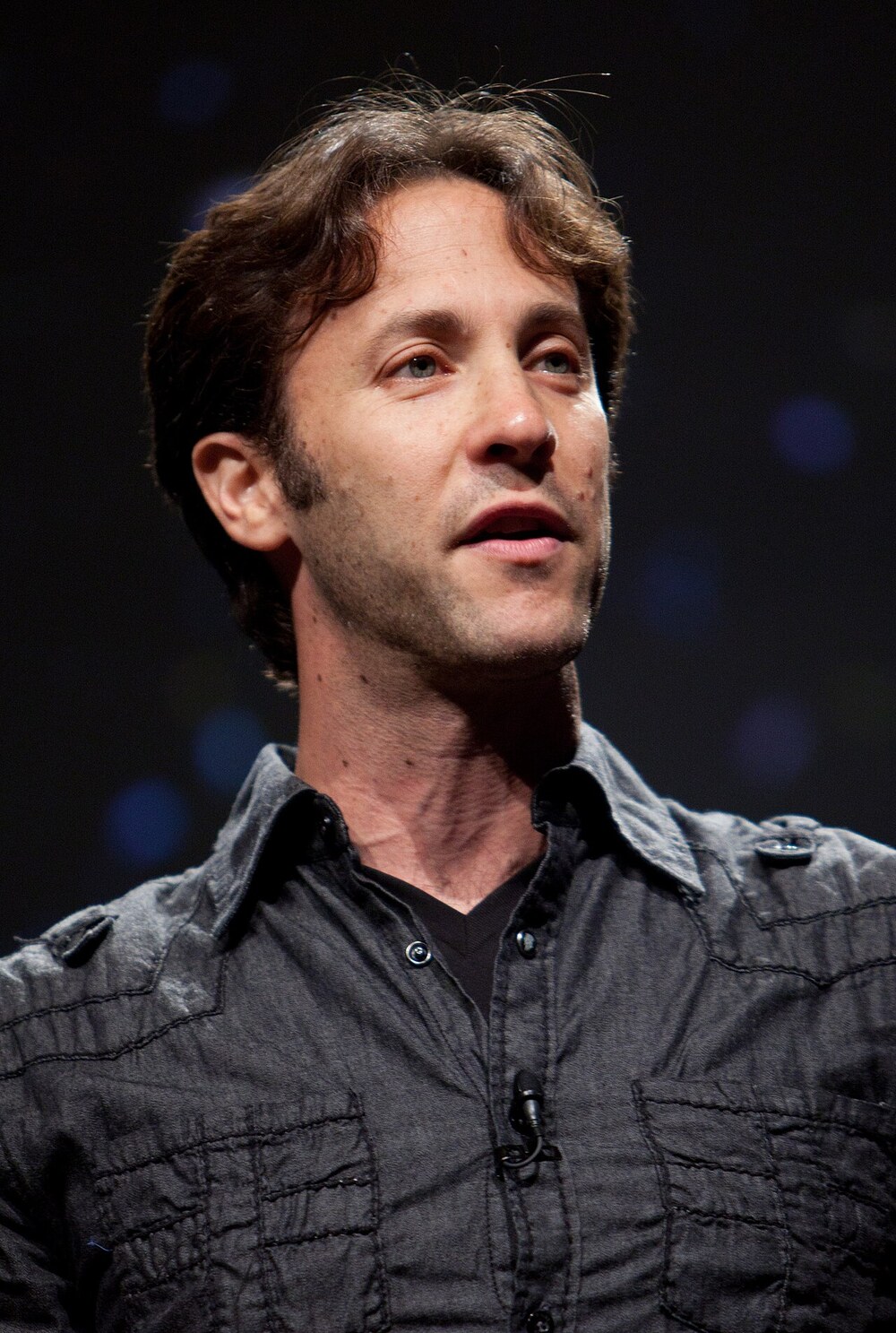
American neuroscientist and author
David Eagleman Quotes: 119 Sayings on Life and Intelligence
The 110 most popular of 119 quotes · By the Quotlr.com Team
David Eagleman is an American neuroscientist, author, and science communicator. He is best known for his work on time perception, brain plasticity, and synesthesia. He is also the director of the Center for Science and Law, a non-profit organization that works to bridge the gap between science and law. Following is our collection on famous quotes by David Eagleman on life, intelligence, education.
- Born
- April 25, 1971
- Died
- 1915
- Known as
- American Neuroscientist
10 quotes
Top 10 David Eagleman Quotes
-
1.
What we find is that our brains have colossal things happening in them all the time.
-
2.
As an undergraduate I majored in British and American literature at Rice University.
-
3.
It turns out your conscious mind - the part you think of as you - is really the smallest part of what’s happening in your brain, and usually the last one in line to find out any information.
-
4.
Love was not specified in the design of your brain; it is merely an endearing algorithm that freeloads on the leftover processing cycles.
-
5.
Your brain is built of cells called neurons and glia - hundreds of billions of them. Each one of these cells is as complicated as a city.
- Advertisement
-
6.
I know one lab that studies nicotine receptors and all the scientists are smokers, and another lab that studies impulse control and they're all overweight.
-
7.
We don't really understand most of what's happening in the cosmos. Is there any afterlife? Who knows.
-
8.
What a life in science really teaches you is the vastness of our ignorance.
-
9.
It is the most wondrous thing we have discovered in the universe, and it is us.
-
10.
To a space alien or a German Shepherd dog, two humans would be indistinguishable, just as attractive and unattractive space aliens and German Shepherd dogs are difficult for you to tell apart.
10 short quotes
David Eagleman Short Quotes
-
Our reality depends on what our biology is up to.
-
There are an infinite number of boring things to do in science.
-
I always bounce my legs when I'm sitting.
-
Neuroscience over the next 50 years is going to introduce things that are mind-blowing.
-
...you are battered and bruised in the collisions between reminiscence and reality.
-
We believe we're seeing the world just fine until it's called to our attention that we're not.
-
Visual cortex is fundamentally a machine whose job is to generate a model of the world.
- Advertisement
-
Just give the brain the information and it will figure it out.
-
We are not the ones driving the boat of our behavior, at least not nearly as much as we believe.
-
As we develop better technologies for probing the brain, we detect more problems.
On life · 7 quotes
David Eagleman Quotes About Life
-
If you have certain problems with your brain but are raised in a good home, you might turn out okay. If your brain is fine and your home is terrible, you might still turn out fine. But if you have mild brain damage and end up with a bad home life, you're tossing the dice for a very unlucky synergy.
-
It is only through us that God lives. When we abandon him, he dies.
-
All life is no more than a match struck in the dark and blown out again.
-
All life will die, all mind will cease, and it will all be as if it had never happened. That, to be honest, is the goal to which evolution is traveling, that is the "benevolent" end of the furious living and furious dying.
-
The majority of human beings live their whole lives unaware that they are only seeing a limited cone of vision at any moment.
-
I spent my adult life as a scientist, and science is, essentially, the most successful approach we have to try and understand the vast mysteries around.
-
Our internal life and external actions are steered by biological coctails to which we have neither immediate access nor direct acquaintance.
On brain · 10 quotes
David Eagleman Quotes About Brain
-
Constant reminding ourselves that we not see with our eyes but with our synergetic eye-brain system working as a whole will produce constant astonishment as we notice, more and more often, how much of our perceptions emerge from our preconceptions.
-
Many people prefer a view of human nature that includes a true side and a false side - in other words, humans have a single genuine aim and the rest is decoration, evasion, or cover-up. That's intuitive, but it's incomplete. A study of the brain necessitates a more nuanced view of human nature.
- Advertisement
-
The conscious mind is not at the center of the action in the brain; instead, it is far out on a distant edge, hearing but whispers of the activity.
-
All activity in the brain is driven by other activity in the brain, in a vastly complex, interconnected network.
-
After all, across the population there are slight differences in brain function, and sometimes these translate directly into different ways of experiencing the world. And each individual believes his way is reality.
-
Reductionism is not the right viewpoint for everything, and it certainly won't explain the relationship between the brain and the mind. This is because of a feature known as emergence. When you put together large numbers of pieces and parts, the whole can become something greater than the sum.
-
Even though the outside world has not changed, your brain dynamically presents different interpretations.
-
The brain runs its show incognito.
-
The main thing known about secrets is that keeping them is unhealthy for the brain.
-
Given the billions of neurons, this means there are as many connections in a single cubic centimeter of brain tissue as there are stars in the Milky Way galaxy.
On perception · 3 quotes
David Eagleman Quotes About Perception
-
The brain internally simulates what will happen if you were to perform some action under specific conditions. Internal models not only play a role in motor acts (such as catching or dodging) but also underlie conscious perception.
-
Asleep vision (dreaming) is perception that is not tied down to anything in the real world; waking perception is something like dreaming with a little more commitment to what's in front of you.
-
We're trapped on this very thin slice of perception ... But even at that slice of reality that we call home, we're not seeing most of what's going on.
70 quotes
David Eagleman Famous Quotes And Sayings
-
There are three deaths. The first is when the body ceases to function. The second is when the body is consigned to the grave. The third is that moment, sometime in the future, when your name is spoken for the last time.
- Advertisement
-
In my view, the argument from parsimony is really no argument at all - it typically functions only to shut down more interesting discussion. If history is any guide, it's never a good idea to assume that a scientific problem is cornered.
-
If choices and decisions derive from hidden mental processes, then free choice is either an illusion or, at minimum, more tightly constrained than previously considered.
-
Who we can be begins with our molecular blueprints - a series of alien codes penned in invisibly small strings of acids - well before we have anything to do with it. We are a product of our inaccessible, microscopic history.
-
People wouldn't even go into science unless there was something much bigger to be discovered, something that is transcendent.
-
When we're in a human body, we don't care about universal collapse - instead, we care only about a meeting of the eyes, a glimpse of bare flesh, the caressing tones of a loved voice, joy, love, light, the orientation of a house plant, the shade of a paint stroke, the arrangement of hair.
-
Imbalance of reason and emotion may explain the tenacity of religion in societies: world religions are optimized to tap into the emotional networks, and great arguments of reason amount to little against such magnetic pull.
-
If you measure someone's brain and see very little activity during a task, it does not necessarily indicate that they're not trying - it more likely signifies that they have worked hard in the past to burn the programs into the circuitry. Consciousness is called in during the first phase of learning and is excluded from the game playing after it is deep in the system.
-
If you are a carrier of a particular set of genes, your probability of committing a violent crime goes up by eight hundred and eighty-two percent.
-
When a male vole repeatedly mates with a female, a hormone called vasopressin is released in his brain. The vasopressin binds to receptors in a part of the brain called the nucleus accumbens, and the binding mediates a pleasurable feeling that becomes associated with that female. This locks in the monogamy, which is known as pair-bonding. If you block this hormone, the pair-bonding goes away.
-
The drives you take for granted ("I'm a hetero/homosexual," "I'm attracted to children/adults," "I'm aggressive/not aggressive," and so on) depend on the intricate details of your neural machinery.
-
Odor carries a great deal of information, including information about a potential mate's age, sex, fertility, identity, emotions, and health.
-
This is what consciousness does: it sets the goals, and the rest of the system learns how to meet them.
-
None of the individual metal hunks of an airplane have the property of flight, but when they are attached together in the right way, the result takes to the air. A thin metal bar won't do you much good if you're trying to control a jaguar, but several of them in parallel have the property of containment. The concept of emergent properties means that something new can be introduced that is not inherent in any of the parts.
-
We are not at the center of ourselves, but instead - like the Earth in the Milky Way, and the Milky Way in the universe - far out on a distant edge, hearing little of what is transpiring.
-
At least 15 percent of human females possess a genetic mutation that gives them an extra (fourth) type of color photoreceptor - and this allows them to discriminate between colors that look identical to the majority of us with a mere three types of color photoreceptors.
-
Think about the brain as the densest concentration of youness. It's the peak of the mountain, but not the whole mountain.
-
In the traditionally taught view of perception, data from the sensorium pours into the brain, works its way up the sensory hierarchy, and makes itself seen, heard, smelled, tasted, felt - "perceived." But a closer examination of the data suggests this is incorrect. The brain is properly thought of as a mostly closed system that runs on its own internally generated activity.
-
We spend our lives on a thin slice between the unimaginably small scales of the atoms that compose us and the infinitely large scales of galaxies.
-
Some men may be genetically inclined to have and hold a single partner, while some may not. In the near future, young women who stay current with the scientific literature may demand genetic tests of their boyfriends to assess how likely they are to make faithful husbands.
-
You are part of a complex social network that changes your biology with every interaction, and which your actions can change.
-
Those with Anton's syndrome are not pretending they are not blind; they truly believe they are not blind. Their verbal reports, while inaccurate, are not lies. Instead, they are experiencing what they take to be vision, but it is all internally generated.
-
Awareness of your surroundings occurs only when sensory inputs violate expectations. When the world is successfully predicted away, awareness is not needed because the brain is doing its job well.
-
It turns out that dopamine is a chemical on double duty in the brain. Along with its role in motor commands, it also serves as the main messenger in the reward systems, guiding a person toward food, drink, mates, and all things useful for survival. Because of its role in the reward system, imbalances in dopamine can trigger gambling, overeating, and drug addiction - behaviors that result from a reward system gone awry.
-
When one part of the brain makes a choice, other parts can quickly invent a story to explain why. If you show the command "Walk" to the right hemisphere (the one without language), the patient will get up and start walking. If you stop him and ask why he's leaving, his left hemisphere, cooking up an answer, will say something like "I was going to get a drink of water."
-
Modern neuroimaging is like asking an astronaut in the space shuttle to look out the window and judge how America is doing.
-
Even while it's true that we are tied to our molecules and proteins and neurons - as strokes and hormones and drugs and microorganisms indisputably tell us - it does not logically follow that humans are best described only as pieces and parts.
-
It is more parsimonious to assume that the sun goes around the Earth, that atoms at the smallest scale operate in accordance with the same rules that objects at larger scales follow, and that we perceive what is really out there. All of these positions were long defended by argument from parsimony, and they were all wrong.
-
Scientists often talk of parsimony (as in "the simplest explanation is probably correct," also known as Occam's razor), but we should not get seduced by the apparent elegance of argument from parsimony; this line of reasoning has failed in the past at least as many times as it has succeeded.
-
You gleefully say, "I just thought of something!", when in fact your brain performed an enormous amount of work before your moment of genius struck. When an idea is served up from behind the scenes, your neural circuitry has been working on it for hours or days or years, consolidating information and trying out new combinations. But you take credit without further wonderment at the vast, hidden machinery behind the scenes.
-
This is the hallmark of a robust biological system: political parties can perish in a tragic accident and the society will still run, sometimes with little more than a hiccup to the system. It may be that for every strange clinical case in which brain damage leads to a bizarre change in behavior or perception, there are hundreds of cases in which parts of the brain are damaged with no detectable clinical sign.
-
One of the most impressive features of brains - and especially human brains - is the flexibility to learn almost any kind of task that comes its way.
-
In our current understanding of science, we can't find the physical gap in which to slip free will - the uncaused causer - because there seems to be no part of the machinery that does not follow in a causal relationship from the other parts.
-
The continuous networks of neural circuitry accomplish their functions using multiple, independently discovered strategies. The brain lends itself well to the complexity of the world, but poorly to clear-cut cartography.
-
Because vision appears so effortless, we are like fish challenged to understand water.
-
Nothing is inherently tasty or repulsive - it depends on your needs. Deliciousness is simply an index of usefulness.
-
Just like a good drama, the human brain runs on conflict.
-
Behavior is the outcome of the battle among internal systems.
-
Knowing yourself now requires the understanding that the conscious you occupies only a small room in the mansion of the brain, and that it has little control over the reality constructed for you.
-
When people fall in love, there´s period of up to three years during which the zeal and infatuation ride at a peak. The internal signals in the body and breain are literally a love drug. And then it beginds to decline. From this perspective, we are preprogramed to lose interest in a sexual partner after the time required to raise a child has passed - which is, on average, about 4 years.
-
Keep in mind that every single generation before us has worked under the assumption that they possessed all the major tools for understanding the universe, and they were all wrong, without exception.
-
Once you begin deliberating about where your fingers are jumping on the piano keyboard, you can no longer pull off the piece.
-
You are more likely to believe that a statement is true if you have heard it before - whether or not it is actually true.
-
Consciousness is the smallest player in the operations of the brain.
-
Interestingly, schizophrenics can tickle themselves because of a problem with their timing that does not allow their motor actions and resulting sensations to be correctly sequenced.
-
The first thing we learn from studying our own circuitry is a simple lesson: most of what we do and think and feel is not under our conscious control.
-
As Carl Jung put it, "In each of us there is another whom we do not know." As Pink Floyd sang, "There's someone in my head, but it's not me."
-
Each cell sends electrical pulses to other cells, up to hundreds of times per second. If you represented each of these trillions and trillions of pulses in your brain by a single photon of light, the combined output would be blinding.
-
The deep secret of the brain is that not only the spinal cord but the entire central nervous system works this way: internally generated activity is modulated by sensory input. In this view, the difference between being awake and being asleep is merely that the data coming in from the eyes anchors the perception.
-
If our brains were simple enough to be understood, we wouldn't be smart enough to understand them.
-
Brains are like representative democracies. They are built of multiple, overlapping experts who weigh in and compete over different choices.
-
We are not conscious of most things until we ask ourselves questions about them.
-
If you ever feel lazy or dull, take heart: you're the busiest, brightest thing on the planet.
-
Who you are depends on the sum total of your neurobiology.
-
One of the most pervasive mistakes is to believe that our visual system gives a faithful representation of what is "out there" in the same way that a movie camera would.
-
The first lesson about trusting your senses is: don't. Just because you believe something to be true, just because you know it's true, that doesn't mean it is true.
-
Vision is more than looking.
-
When the brain activity is kindled in the right spot, people hear voices. If a physician prescribes an anti-epileptic medication, the seizures go away and the voices disappear. Our reality depends on what our biology is up to.
-
Everybody knows the power of deadlines - and we all hate them. But their effectiveness is undeniable.
-
The more familiar the world becomes, the less information your brain writes down, and the more quickly time seems to pass.
-
What has always surprised me when I walk into a bookstore is the number of books that you can find that are written with certainty. The authors tell some story as though it's true, but they don't have any evidence that it is true!
-
The three-pound organ in your skull - with its pink consistency of Jell-o - is an alien kind of computational material. It is composed of miniaturized, self-configuring parts, and it vastly outstrips anything we've dreamt of building.
-
Every week I get letters from people worldwide who feel that the possibilian point of view represents their understanding better than either religion or neo-atheism.
-
I call myself a Possibilian: I'm open to...ideas that we don't have any way of testing right now.
-
There are always wonderful mysteries to confront.
-
You´re not perceiving what's out there. You're perceiving whatever your brain tells you.
-
Death... The moment, sometime in the future, when your name is spoken for the last time.
-
Humans have discovered that they cannot stop Death, but at least they can spit in his drink.
-
Societies would _not_ be better off if everyone were like Mr Spock, all rationality and no emotion. Instead, a balance - a teaming up of the internal rivals - is optimal for brains. ... Some balance of the emotional and rational systems is needed, and that balance may already be optimized by natural selection in human brains.
-
Evolve solutions; when you find a good one, don't stop.
Life Lessons by David Eagleman
- David Eagleman's work has taught us the importance of understanding how the brain works and how it affects our behavior and experiences.
- He has also highlighted the potential of using technology to gain a better understanding of the brain, and the potential of using technology to treat neurological disorders.
- Finally, his work has shown us the importance of looking beyond what we think we know and exploring new possibilities in the field of neuroscience.
Cite this page · Portrait: PopTech, CC BY-SA 2.0, via Wikimedia Commons
