
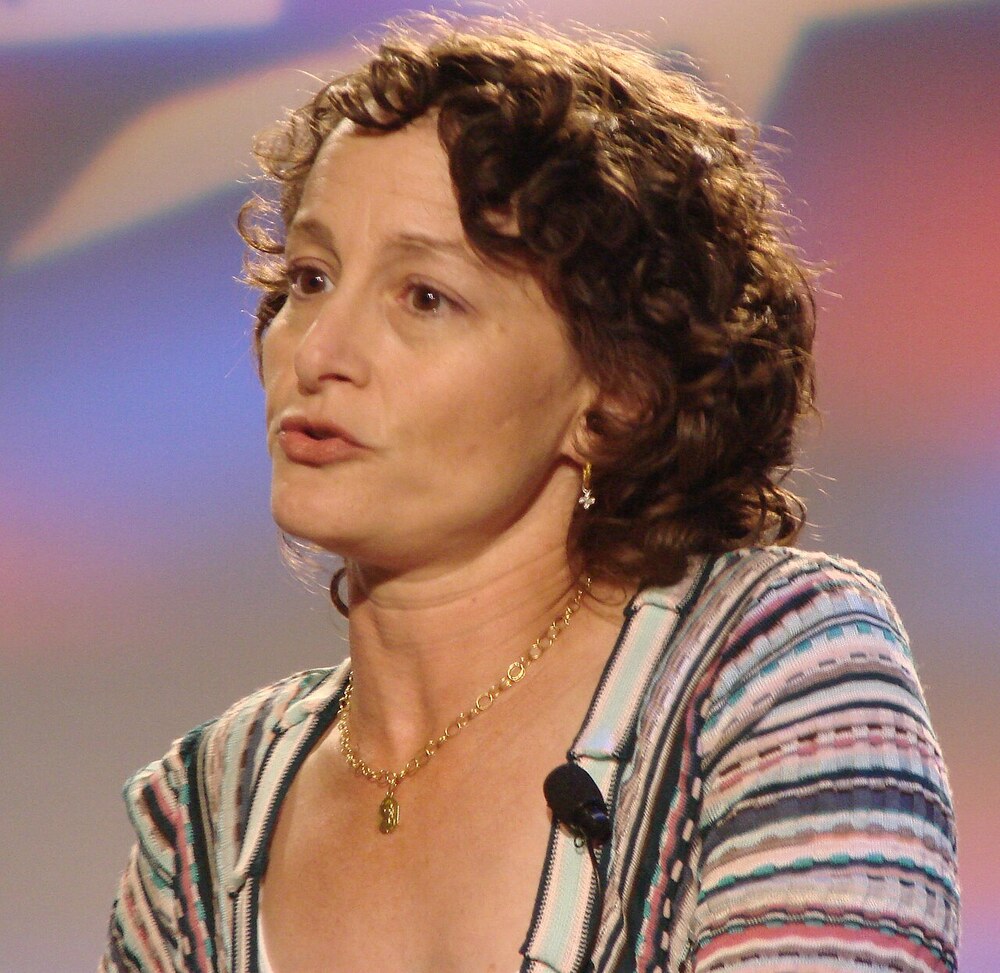
American studio executive
Nina Jacobson Quotes: 41 Sayings on Education, Life and Love
By the Quotlr.com Team
Nina Jacobson is an American film producer. She is best known for producing the popular films The Hunger Games, Diary of a Wimpy Kid and Crazy Rich Asians. She is the co-founder of Color Force, a production company based in Los Angeles. Following is our collection on famous quotes by Nina Jacobson on education, life, love.
- Born
- 1965
- Known as
- American Film producer
10 quotes
Top 10 Nina Jacobson Quotes
-
1.
It's an exciting time, when you can make your movie on a cellphone. If it's good, it WILL get noticed.
-
2.
Suzanne [Collins] was very involved in the development of the script. She wrote the first draft. She was very involved with Billy Ray, when he wrote his draft.
-
3.
Nobody roots for people who presume success. You have to earn success, and success is earned by making a movie that audiences like and want to see more of.
-
4.
Only audiences decide what's a franchise. Only audiences decide what's a hit. I have always been mindful of not wanting to be the Miami Heat of movies.
-
5.
I've always tried to really focus on The Hunger Games movie, knowing that, yes, these are amazing books and I would feel like a failure, if I didn't get all three of them made.
- Advertisement
-
6.
Deb Zane, our casting director on the Hunger Games was very sanguine, from the beginning, about just blocking out what everybody else says that they want.
-
7.
I never had to put myself in somebody else's shoes.
-
8.
I'm an ardent fan. All I really had to do was put myself in my own shoes.
-
9.
Little decisions were made, every day. In this movie [The Hunger Games], we really focused on Cinna and we didn't get time to focus on the other stylist.
-
10.
You're not doing the scene exactly the way it is in the book [The Hunger Games], but the intention of the scene is there.
4 short quotes
Nina Jacobson Short Quotes
-
The "If you build it, they will come" approach to filmmaking has always been helpful to me.
-
You are there to support the vision of the people who you choose to excute the movie.
-
Ultimately, only audiences decide what's a franchise.
-
Ultimately, I am very filmmaker oriented, as a producer.
27 quotes
Nina Jacobson Famous Quotes And Sayings
-
I was an executive before I was a producer, and I've seen franchise fever grow, over the course of my career. The one thing that people always forget is that it's only a franchise if audiences really want to see more of it. It's up to them. It's really not up to us.
-
Suzanna Collins was very supportive, but we very much wanted her blessing on casting. In production, she visited us once, but she really was not involved in the production process. She's seen the Hunger Games movie twice, in the post-production process, once as an early cut and then once when it was finished.
-
I was focused on The Hunger Games movie with my director, with the studio, and with the cast and crew. We all just focused on making the best possible movie we could, and earning the right to do more.
- Advertisement
-
I love the Hunger Games books. Certainly, the fans are there. They're grown enormously since the beginning. When I first brought the books to Lionsgate, they had sold about 150,000 copies, which is a very good result for a YA book. And to their credit, Lionsgate was very excited and committed to the movie, from the beginning.
-
If the movie [The Hunger Games] were stylized violence that was pretty and fun and cool, which is great when you go see 300 or The Matrix, it would just be out of sync with the fact that they're kids.
-
We didn't want to dilute or soften the material because that would really be irresponsible, in its own way. The [Hunger Games] books are very intense and very demanding of the reader, and the movie should be that too.
-
We knew that we wanted TheHunger Games to be PG-13 because she wrote the book for readers 12 and up, and we wanted them to be able to see the movie. It's a movie that is meant to be relevant to young people, and not exclude them, in any way.
-
Being able to just stick to our instincts and honor the [Hunger Games] books and find a way to stay the course of trying to make the best possible decisions that you would make creatively on any movie, without having your head turned too much by all of the interest, has been a great challenge. It's the best challenge you could ask for, but that was a big challenge.
-
When fans get very passionate about a movie, they just want you to do it well. They don't want you to screw it up. Their idea of doing it well might be different than yours, but ultimately, they really just don't want you to mess up the thing that they love.
-
When you read a book [The Hunger Games], you create that tonal bandwidth. You set a tone for yourself, as you're reading it, in which everything exists within the world of your imagination. In the book, it's great when she can push a button and food comes up, as per your order.
-
In the evolution of the [The Hunger Games] movie, Gary [Ross] and I talked a lot about tonal bandwidth and making sure that the look and feel and style and choices of the movie stayed within a certain consistent bandwidth.
-
The hiring of Phil Messina, the production designer, was a big decision. He's so gifted, and his ideas were always so smart and rooted in American history and architecture. Nothing feels like it's not us, or couldn't be us, and I think that's very important.
-
I felt that with each movie, Gary [Ross] adopts a different style. He doesn't have one look that's the Gary Ross look, and I thought that was important.
-
It was very important to me to choose a director like Gary [Ross], whose instincts come from character, who's a storyteller, and who puts characters first.
-
I am very filmmaker oriented, as a producer. I think the most important thing is that you have to really choose the players carefully.
- Advertisement
-
I felt that there were so many things that could go wrong, in adapting The Hunger Games , and I had this fierce desire to protect this book that she had written. At that time, I read the second book, in manuscript form, and so I saw where she was going with the series. I was able to convince Suzanne [Collins] to trust me with the books.
-
The most important part of filmmaking is the collaboration and the ensemble element of it. If you just all focus on the task and the work and try and make the best film that you can then people will come.
-
Women are making strides in many areas and women have mentored and supported me along the way. I think that women are underrepresented behind the camera as directors.
-
It can really vary from movie to movie what the producer's role is and there are all kinds of producers. There are line producers who do a lot of the nuts and bolts work on the set.
-
There's as much great authorship in the filmmaker community as in the literary community, and I'd love to welcome more filmmakers into the fold.
-
I think that one of the greatest perspectives that I have, from being a buyer for my whole career until I became a producer, is that I have a pretty good understanding of the buyers mentality.
-
I can't imagine Hunger Games, even with its very popular books, being nearly a success that it's been without Jen Lawrence being the perfect person to play that role - a very modern celebrity, a very down-to-earth, accessible, celebrity.
-
[On the racial backlash about Hunger Games casting]: "People should have ignored the five racist idiots.
-
[On The Hunger Games success]: "It hit on the zeitgeist of the disparity b/w the haves and have nots.
-
The most powerful decision-making part of the audience is women. Boys have a lot of impact on the industry, but it's often women who impact what stories get made.
-
As a producer, you can't break up w/your own project. It's like sleeping with someone that you don't like... Forever.
-
I'm very superstitious. I come from a family that's big on not painting the nursery until the baby is home.
- Advertisement
Life Lessons by Nina Jacobson
- Nina Jacobson's work demonstrates that hard work and dedication to your craft can pay off, as she has achieved success in the film industry despite the challenges of being a woman in a male-dominated field.
- Her success also shows that taking risks and being open to new opportunities can lead to great rewards.
- Finally, Jacobson's story is a reminder that it is possible to make a name for yourself in the entertainment industry, even if you don't have traditional connections or resources.
Cite this page · Portrait: atp_tyreseus (Jere Keys), CC BY 2.0, via Wikimedia Commons
