
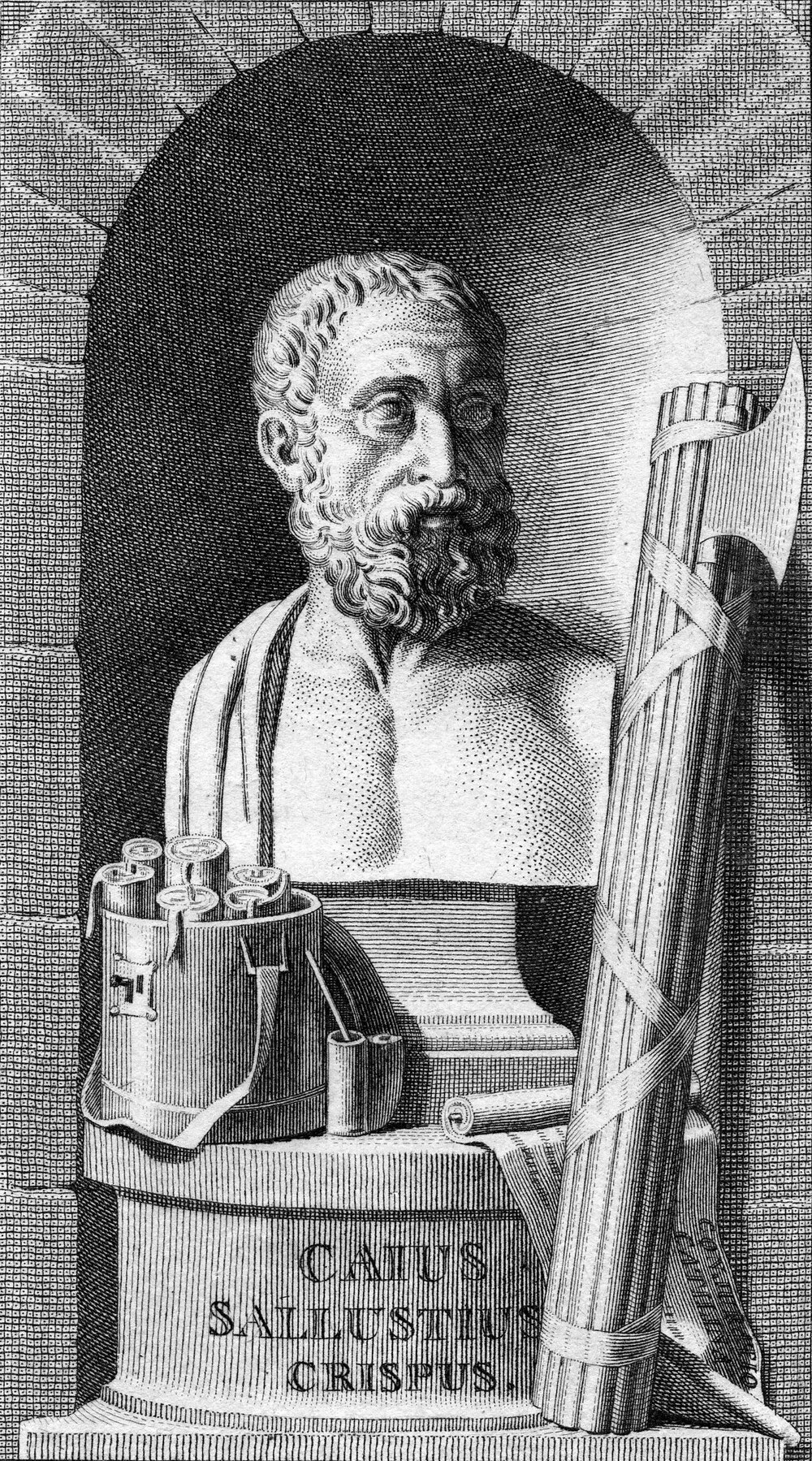
Sallust was a Roman historian who lived in the 1st century BC. He was known for his monographs on the Catiline Conspiracy and the Jugurthine War. His works are known for their vivid accounts of Roman politics in the late Republic. Following is our collection on famous quotes by Sallust on religion, death, justice.
- Died
- 35 BC
- Known as
- Roman Historian
10 quotes
Top 10 Sallust Quotes
-
1.
He that will be angry for anything will be angry for nothing.
-
2.
The firmest friendship is based on an identity of likes and dislikes.
-
3.
Small communities grow great through harmony, great ones fall to pieces through discord.
-
4.
Everything rises but to fall, and increases but to decay.
-
5.
Necessity makes even the timid brave.
- Advertisement
-
6.
Greedy for the property of others, extravagant with his own
-
7.
All those who offer an opinion on any doubtful point should first clear their minds of every sentiment of dislike, friendship, anger or pity.
-
8.
A small state increases by concord; the greatest falls gradually to ruin by dissension.
-
9.
They envy the distinction I have won; let them therefore, envy my toils, my honesty, and the methods by which I gained it.
-
10.
Neither soldiers nor money can defend a king but only friends won by good deeds, merit, and honesty.
10 short quotes
Sallust Short Quotes
-
In my opinion it is less shameful for a king to be overcome by force of arms than by bribery.
-
It is better to use fair means and fail, than foul and conquer.
-
Each man the architect of his own fate.
-
In battle it is the cowards who run the most risk; bravery is a rampart of defense.
-
A good man would prefer to be defeated than to defeat injustice by evil means.
-
By union the smallest states thrive. By discord the greatest are destroyed.
-
Every bad precedent originated as a justifiable measure.
- Advertisement
-
No mortal man has ever served at the same time his passions and his best interests.
-
Ambition breaks the ties of blood, and forgets the obligations of gratitude.
-
Before you act, consider; when you have considered, tis fully time to act.
On nature · 5 quotes
Sallust Quotes About Nature
-
It is the nature of ambition to make men liars and cheats, to hide the truth in their breasts, and show, like jugglers, another thing in their mouths, to cut all friendships and enmities to the measure of their own interest, and to make a good countenance without the help of good will.
-
It is a law of human nature that in victory even the coward may boast of his prowess, while defeat injures the reputation even of the brave.
-
In my own case, who have spent my whole life in the practice of virtue, right conduct from habitual has become natural.
-
All men who would surpass the other animals should do their best not to pass through life silently like the beasts whom nature made prone, obedient to their bellies.
-
All persons who are enthusiastic that they should transcend the other animals ought to strive with the utmost effort not to pass through a life of silence, like cattle, which nature has fashioned to be prone and obedient to their stomachs.
On war · 3 quotes
Sallust Quotes About War
-
It is always easy enough to take up arms, but very difficult to lay them down; the commencement and the termination of war are notnecessarily in the same hands; even a coward may begin, but the end comes only when the victors are willing.
-
It is always easy to begin a war, but very difficult to stop one.
-
But at power or wealth, for the sake of which wars, and all kinds of strife, arise among mankind, we do not aim; we desire only our liberty, which no honorable man relinquishes but with his life.
On political · 3 quotes
Sallust Quotes About Political
-
The poorest of men are the most useful to those seeking power.
- Advertisement
-
A good man prefers to suffer rather than overcome injustice with evil.
-
Few men desire liberty; most men wish only for a just master.
On friendship · 8 quotes
Sallust Quotes About Friendship
-
To like and dislike the same things that is indeed true friendship.
-
All who consult on doubtful matters, should be void of hatred, friendship, anger, and pity.
-
Neither the army nor the treasury, but friends, are the true supports of the throne; for friends cannot be collected by force of arms, nor purchased with money; they are the offspring of kindness and sincerity.
-
To like and dislike the same things, this is what makes a solid friendship.
-
To have the same desires and the same aversion is assuredly a firm bond of friendship.
-
To have the same likes and dislikes, therein consists the firmest bond of friendship.
-
To desire the same things and to reject the same things, constitutes true friendship. [Lat., Idem velle et idem nolle ea demum firma amicitia est.]
-
The Romans assisted their allies and friends, and acquired friendships by giving rather than receiving kindness. [Lat., Sociis atque amicis auxilia portabant Romani, magisque dandis quam accipiundis beneficiis amicitias parabant.]
On fortune · 7 quotes
Sallust Quotes About Fortune
-
But assuredly Fortune rules in all things; she raised to eminence or buries in oblivion everything from caprice rather than from well-regulated principle. [Lat., Sed profecto Fortuna in omni re dominatur; ea res cunctas ex lubidine magis, quam ex vero, celebrat, obscuratque.]
-
As the blessings of health and fortune have a beginning, so they must also find an end. Everything rises but to fall, and increases but to decay.
- Advertisement
-
Every man is the architect of his own fortune.
-
If fortune makes a wicked man prosperous and a good man poor, there is no need to wonder. For the wicked regard wealth as everything, the good as nothing. And the good fortune of the bad cannot take away their badness, while virtue alone will be enough for the good.
-
Sovereignty is easily preserved by the very arts by which it was originally created. When, however, energy has given place to indifference, and temperance and justice to passion and arrogance, then as the morals change so changes fortune.
-
That power of the Gods which orders for the good things which are not uniform, and which happen contrary to expectation, is commonly called Fortune, and it is for this reason that the Goddess is especially worshipped in public by cities; for every city consists of elements which are not uniform.
-
Fortune rules in all things, and advances and depresses things more out of her own will than right and justice.
64 quotes
Sallust Famous Quotes And Sayings
-
The renown which riches or beauty confer is fleeting and frail mental excellence is a splendid and lasting possession.
-
Since we have received everything from the Gods, and it is right to pay the giver some tithe of his gifts, we pay such a tithe of possessions in votive offering, of bodies in gifts of (hair and) adornment, and of life in sacrifices.
-
Those most moved to tears by every word of a preacher are generally weak and a rascal when the feelings evaporate.
-
Kings are more prone to mistrust the good than the bad; and they are always afraid of the virtues of others.
-
Distinguished ancestors shed a powerful light on their descendants, and forbid the concealment either of their merits or of their demerits.
-
Poor Britons, there is some good in them after all - they produced an oyster.
-
Advise well before you begin, and when you have maturely considered, then act with promptitude.
-
Ambition drove many men to become false; to have one thought locked in the breast, another ready on the tongue.
-
We employ the mind to rule, the body to serve.
-
Not by vows nor by womanish prayers is the help of the gods obtained; success comes through vigilance, energy, wise counsel.
-
The fame which is based on wealth or beauty is a frail and fleeting thing; but virtue shines for ages with undiminished lustre.
-
For harmony makes small states great, while discord undermines the mightiest empires.
-
The fame that goes with wealth and beauty is fleeting and fragile; intellectual superiority is a possession glorious and eternal.
-
The soul is the captain and ruler of the life of morals.
-
The glory that goes with wealth is fleeting and fragile; virtue is a possession glorious and eternal.
-
No man underestimates the wrongs he suffers; many take them more seriously than is right.
-
Harmony makes small things grow, lack of it makes great things decay.
-
Small endeavours obtain strength by unity of action: the most powerful are broken down by discord.
-
Just to stir things up seemed a great reward in itself.
-
Most honorable are services rendered to the State; even if they do not go beyond words, they are not to be despised.
-
He only seems to me to live, and to make proper use of life, who sets himself some serious work to do, and seeks the credit of a task well and skillfully performed.
-
In my opinion, he only may be truly said to live and enjoy his being who is engaged in some laudable pursuit, and acquires a name by some illustrious action, or useful art.
-
Before you act consider when you have considered, tis fully time to act.
-
But the case has proved that to be true which Appius says in his songs, that each man is the maker of his own fate.
-
For men who had easily endured hardship, danger and difficult uncertainty, leisure and riches, though in some ways desirable, proved burdensome and a source of grief.
-
Everything that rises sets, and everything that grows, grows old.
-
There were few who preferred honor to money.
-
When the prizes fall to the lot of the wicked, you will not find many who are virtuous for virtue's sake.
-
If the transmigration of a soul takes place into a rational being, it simply becomes the soul of that body. But if the soul migrates into a brute beast, it follows the body outside, as a guardian spirit follows a man. For there could never be a rational soul in an irrational being.
-
Souls are punished when they have gone forth from the body, some wandering among us, some going to hot or cold places of the earth, some harassed by spirits. Under all circumstances they suffer with the irrational part of their nature, with which they also sinned. For its sake there subsists that shadowy body which is seen about graves, especially the graves of evil livers.
-
It is not only spirits who punish the evil, the soul brings itself to judgment: and also it is not right for those who endure for ever to attain everything in a short time: and also, there is need of human virtue. If punishment followed instantly upon sin, men would act justly from fear and have no virtue.
-
It is not unlikely, too, that the rejection of God is a kind of punishment: we may well believe that those who knew the Gods and neglected them in one life may in another life be deprived of the knowledge of them altogether. Also those who have worshipped their own kings as gods have deserved as their punishment to lose all knowledge of God.
-
Again, if the world is destroyed, it must needs either be destroyed according to nature or against nature. Against nature is impossible, for that which is against nature is not stronger than nature. If according to nature, there must be another nature which changes the nature of the world: which does not appear.
-
Everything destroyed is either resolved into the elements from which it came, or else vanishes into not-being. If things are resolved into the elements from which they came, then there will be others: else how did they come into being at all?
-
The Gods being good and making all things, there is no positive evil, it only comes by absence of good; just as darkness itself does not exist, but only comes about by absence of light.
-
The fact that the stars predict high or low rank for the father of the person whose horoscope is taken, teaches that they do not always make things happen but sometimes only indicate things. For how could things which preceded the birth depend upon the birth?
-
It is impossible that there should be so much providence in the last details, and none in the first principles. Then the arts of prophecy and of healing, which are part of the cosmos, come of the good providence of the Gods.
-
While the body is young and fine, the soul blunders, but as the body grows old it attains its highest power. Again, every good soul uses mind; but no body can produce mind: for how should that which is without mind produce mind? Again, while the soul uses the body as an instrument, it is not in it; just as the engineer is not in his engines (although many engines move without being touched by any one).
-
Of the bodies in the cosmos, some imitate mind and move in orbits; some imitate soul and move in a straight line, fire and air upward, earth and water downward.
-
Of the cosmic Gods some make the world be, others animate it, others harmonize it, consisting as it does of different elements; the fourth class keep it when harmonized.
-
One may call the world a myth , in which bodies and things are visible, but souls and minds hidden. Besides, to wish to teach the whole truth about the Gods to all produces contempt in the foolish, because they cannot understand, and lack of zeal in the good, whereas to conceal the truth by myths prevents the contempt of the foolish, and compels the good to practice philosophy.
-
Now the myths represent the Gods themselves and the goodness of the Gods subject always to the distinction of the speakable and the unspeakable, the revealed and the unrevealed, that which is clear and that which is hidden: since, just as the Gods have made the goods of sense common to all, but those of intellect only to the wise, so the myths state the existence of Gods to all, but who and what they are only to those who can understand.
-
One can ever assume to be what he is not, and to conceal what he is.
-
Deliberate before you begin; but, having carefully done so, execute with vigour.
-
By the wicked the good conduct of others is always dreaded.
-
Enough words, little wisdom. [Lat., Satis eloquentiae sapientiae parum.]
-
The glory of riches and of beauty is frail and transitory; virtue remains bright and eternal. [Lat., Divitarum et formae gloria fluxa atque fragilis; virtus clara aeternaque habetur.]
-
But few prize honour more than money.
-
No one has become immortal by sloth; nor has any parent prayed that his children should live forever; but rather that they should lead an honorable and upright life. [Lat., Ignavia nemo immortalis factus: neque quisquam parens liberis, uti aeterni forent, optavit; magis, uti boni honestique vitam exigerent.]
-
The very life which we enjoy is short. [Lat., Vita ipsa qua fruimur brevis est.]
-
To hope for safety in flight, when you have turned away from the enemy the arms by which the body is defended, is indeed madness. In battle those who are most afraid are always in most danger; but courage is equivalent to rampart.
-
No grief reaches the dead.
-
The man who is roused neither by glory nor by danger it is in vain to exhort; terror closes the ears of the mind. [Lat., Quem neque gloria neque pericula excitant, nequidquam hortere; timor animi auribus officit.]
-
The glory of ancestors sheds a light around posterity; it allows neither good nor bad qualities to remain in obscurity. [Lat., Majorum gloria posteris lumen est, neque bona neque mala in occulto patitur.]
-
The glory of wealth and of beauty is fleeting and frail; virtue is illustrious and everlasting.
-
In victory even the cowardly like to boast, while in adverse times even the brave are discredited.
-
Get good counsel before you begin; and when you have decided, act promptly.
-
Do as much as possible, and talk of yourself as little as possible
-
The higher your station, the less your liberty.
-
To someone seeking power, the poorest man is the most useful.
-
Fame is the shadow of passion standing in the light
-
Among intellectual pursuits, one of the most useful is the recording of past events.
-
Prosperity tries the souls even of the wise.
-
It is sweet to surve one country by deeds, and it is not absurd to surve her by words.
Life Lessons by Sallust
Sallust teaches us to be honest and humble, to strive for excellence and to seek knowledge. He also reminds us to be mindful of our actions and to think carefully before making decisions. Finally, he encourages us to be mindful of our past and to learn from our mistakes so that we can create a better future.
Cite this page · Portrait: Philippe Trière d'après «Maréchal», Public domain, via Wikimedia Commons
