
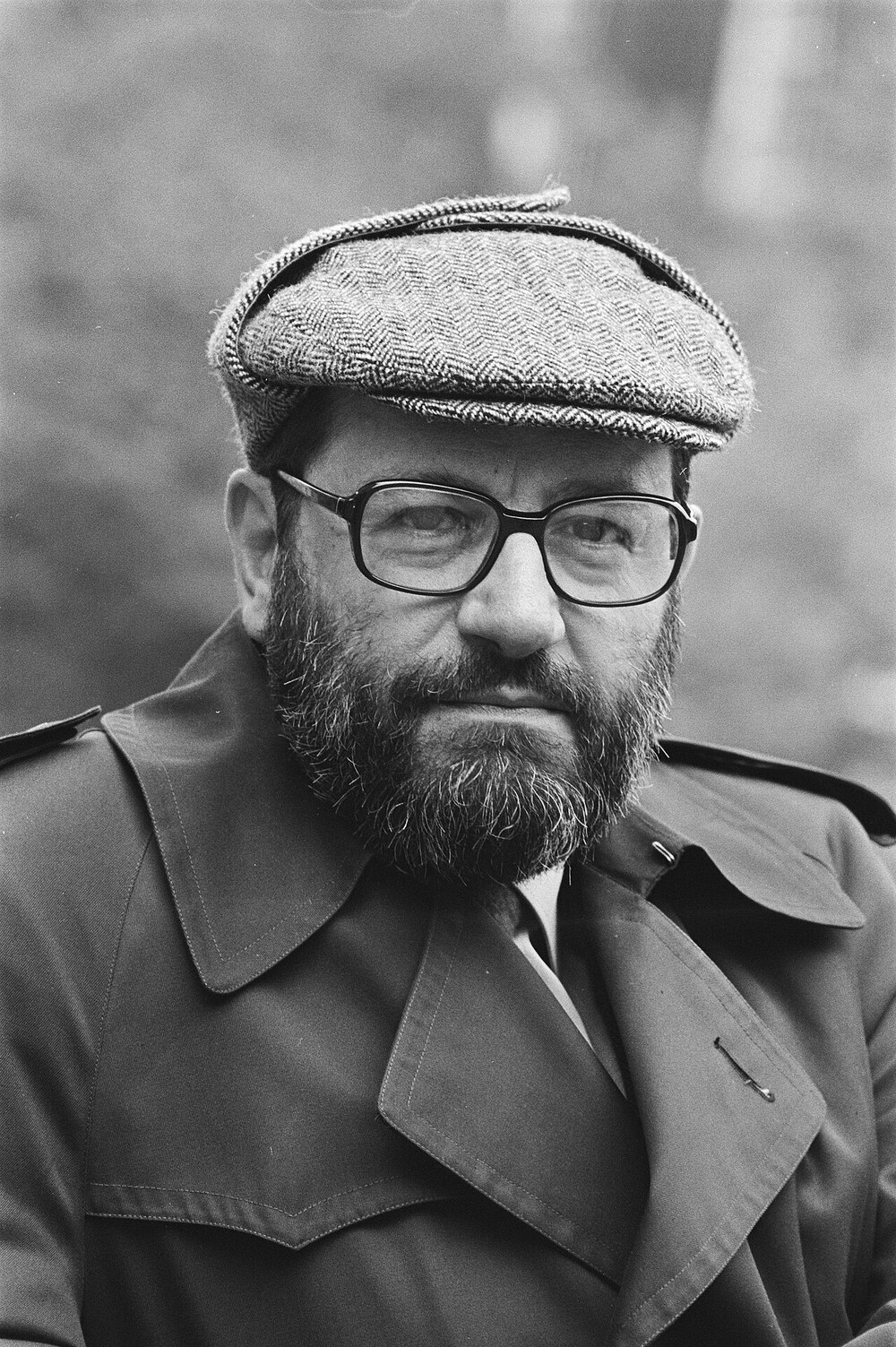
Italian Novelist
Umberto Eco Quotes: 279 Sayings on Books and Beauty
The 110 most popular of 279 quotes · By the Quotlr.com Team
Umberto Eco was an Italian novelist, literary critic, and philosopher. He is best known for his novel The Name of the Rose, which was made into a movie in 1986. Eco was also the author of several other novels, essays, and works of literary criticism. Following is our collection on famous quotes by Umberto Eco on books, beauty, philosophical.
- Died
- February 19, 2016
- Known as
- Italian Novelist
10 quotes
Top 10 Umberto Eco Quotes
-
1.
Nothing gives a fearful man more courage than another's fear.
-
2.
When men stop believing in God, it isn't that they then believe in nothing: they believe in everything.
-
3.
I believe that what we become depends on what our fathers teach us at odd moments, when they aren't trying to teach us. We are formed by little scraps of wisdom.
-
4.
Absence is to love as wind is to fire: it extinguishes the little flame, it fans the big.
-
5.
There are four types: the cretin, the imbecile, the stupid and the mad. Normality is a balanced mixture of all four.
- Advertisement
-
6.
I love the smell of book ink in the morning.
-
7.
To survive, you must tell stories.
-
8.
We are formed by little scraps of wisdom.
-
9.
Reflecting on these complex relationships between reader and story, fiction and life, can constitute a form of therapy against the sleep of reason, which generates monsters.
-
10.
A democratic civilization will save itself only if it makes the language of the image into a stimulus for critical reflection - not an invitation for hypnosis.
4 pictures
Umberto Eco Image Quotes


10 short quotes
Umberto Eco Short Quotes
-
Every great thinker is someone else's moron.
-
What is life if not the shadow of a fleeting dream?
-
The real hero is always a hero by mistake; he dreams of being an honest coward like everybody else.
-
For the enemy to be recognized and feared, he has to be in your home or on your doorstep.
-
The comic is the perception of the opposite; humor is the feeling of it.
-
Translation is the art of failure.
-
Better reality than a dream: if something is real, then it's real and you're not to blame.
- Advertisement
-
Libraries have always been humanities' way of preserving its collective wisdom
-
If you want to use television to teach somebody, you must first teach them how to use television.
-
The real hero is always a hero by mistake.
On books · 10 quotes
Umberto Eco Quotes About Books
-
A book is a fragile creature, it suffers the wear of time, it fears rodents, the elements and clumsy hands. so the librarian protects the books not only against mankind but also against nature and devotes his life to this war with the forces of oblivion.
-
You can be obsessed by remorse all your life, not because you chose the wrong thing- you can always repent, atone : but because you never had the chance to prove to yourself that you would have chosen the right thing.
-
A book is a fragile creature. It suffers the wear of time, it fears rodents, the elements, clumsy hands.
-
libraries are fascinating places: sometimes you feel you are under the canopy of a railway station, and when you read books about exotic places there's a feeling of travelling to distant lands
-
There are magic moments, involving great physical fatigue and intense motor excitement, that produce visions of people known in the past. As I learned later from the delightful little book of the Abbé de Bucquoy, there are also visions of books as yet unwritten.
-
The good of a book lies in its being read. A book is made up of signs that speak of other signs, which in their turn speak of things. Without an eye to read them, a book contains signs that produce no concepts; therefore it is dumb.
-
There are no stories without meaning. And I am one of those men who can find it even when others fail to see it. Afterwards the story becomes the book of the living, like a blaring trumpet that raises from the tomb those who have been dust for centuries....
-
Books are menaced by books. Any excess of information produces silence.
-
The good of a book lies in its being read.
- Advertisement
-
When one starts writing a book, especially a novel, even the humblest person in the world hopes to become Homer.
On beauty · 9 quotes
Umberto Eco Quotes About Beauty
-
All the stories I would like to write persecute me. When I am in my chamber, it seems as if they are all around me, like little devils, and while one tugs at my ear, another tweaks my nose, and each says to me, 'Sir, write me, I am beautiful.
-
Is it possible to say "It was a beautiful morning at the end of November" without feeling like Snoopy?
-
the first quality of an honest man is contempt for religion, which would have us afraid of the most natural thing in the world, which is death; and would have us hate the one beautiful thing destiny has given us, which is life.
-
Show not what has been done, but what can be. How beautiful the world would be if there were a procedure for moving through labyrinths.
-
Ugliness is more inventive than beauty. Beauty always follows certain camps. I think it's more amusing - ugliness - than beauty.
-
The truth is a young maiden as modest as she is beautiful, and therefore she is always seen cloaked.
-
Beauty has never been absolute and immutable but has taken on different aspects depending on the historical period and the country
-
After so many years even the fire of passion dies, and with it what was believed the light of the truth. Who of us is able to say now whether Hector or Achilles was right, Agamemnon or Priam, when they fought over the beauty of a woman who is now dust and ashes?
-
How beautiful was the spectacle of nature not yet touched by the often perverse wisdom of man!
On truth · 10 quotes
Umberto Eco Quotes About Truth
-
I have come to believe that the whole world is an enigma, a harmless enigma that is made terrible by our own mad attempt to interpret it as though it had an underlying truth.
-
Fear prophets and those prepared to die for the truth, for as a rule they make many others die with them, often before them, at times instead of them.
- Advertisement
-
I was the type who looked at discussions of What Is Truth only with a view toward correcting the manuscript. If you were to quote "I am that I am," for example, I thought that the fundamental problem was where to put the comma, inside the quotation marks or outside.
-
Semiotics is in principle the discipline studying everything which can be used in order to lie. If something cannot be used to tell a lie, conversely it cannot be used to tell the truth: it cannot in fact be used "to tell" at all.
-
But now I have come to believe that the whole world is an enigma, a harmless enigma that is made terrible by our own mad attempt to interpret it as though it had an underlying truth.
-
Perhaps the mission of those who love mankind is to make people laugh at the truth, to make truth laugh, because the only truth lies in learning to free ourselves from insane passion for the truth.
-
The only truth lies in learning to free ourselves from insane passion for the truth.
-
To establish what is true is very difficult. Frequently it is easier to establish what is false. And, passing through the false, it's possible to understand something about truth.
-
My collection of rare books concerns only books that don't tell the truth.
-
The truth is an anagram of an anagram.
On book · 9 quotes
Umberto Eco Quotes About Book
-
Naturally, everything depends on one's background books and on what one is looking for.
-
Books always speak of other books.
-
I always assume that a good book is more intelligent than its author. It can say things that the writer is not aware of.
-
Books are not made to be believed, but to be subjected to inquiry.
-
We live for books. A sweet mission in this world dominated by disorder and decay.
-
A monk should surely love his books with humility, wishing their good and not the glory of his own curiosity; but what the temptation of adultery is for laymen and the yearning for riches is for secular ecclesiastics, the seduction of knowledge is for monks.
-
Books are not made to be believed, but to be subjected to inquiry. When we consider a book, we mustn't ask ourselves what it says but what it means.
-
Thus I rediscovered what writers have always known (and have told us again and again): books always speak of other books, and every story tells a story that has already been told.
-
We live for books.
On love · 8 quotes
Umberto Eco Quotes About Love
-
The pleasures of love are pains that become desirable, where sweetness and torment blend, and so love is voluntary insanity, infernal paradise, and celestial hell -- in short, harmony of opposite yearnings, sorrowful laughter, soft diamond.
-
Simple mechanisms do not love.
-
I believe all sin, love, glory are this: when you slide down the knotted sheets, escaping from Gestapo headquarters, and she hugs you, there, suspended, and she whispers that she's always dreamed of you. The rest is just sex, copulation, the perpetuation of the vile species.
-
And what would we be, we sinful creatures, without fear, perhaps the most foresighted, the most loving of the divine gifts?
-
He who falls in love in bars doesn't need a woman all his own. He can always find one on loan.
-
The light in her eyes was beyond description, yet it did not instill improper thoughts: it inspired a love tempered by awe, purifying the hearts it inflamed.
-
Love flourishes in expectation. Expectation strolls through the spacious fields of Time towards Opportunity.
-
Love is wiser than wisdom.
On made · 4 quotes
Umberto Eco Quotes About Made
-
All the blogs, Facebook, Twitter are made by people who want to show their own private affairs at the price of making fakes, to try to appear such as they are not, to construct another personality, which is a veritable loss of identity.
-
Never affirm, always allude: allusions are made to test the spirit and probe the heart.
-
[In my writing] I know that I have made a caricature out of [others' academic] theories [but] I think that caricatures are frequently good portraits.
-
...we can only add to the world, where we believe it ends, more parts similar to those we already know (an expanse made again and always of water and land, stars and skies).
69 quotes
Umberto Eco Famous Quotes And Sayings
-
We have a limit, a very discouraging, humiliating limit: death. That's why we like all the things that we assume have no limits and, therefore, no end. It's a way of escaping thoughts about death. We like lists because we don't want to die.
-
The older I grow and the more I abandon myself to God's will, the less I value intelligence that wants to know and will that wants to do; and as the only element of salvation I recognize faith, which can wait patiently, without asking too many questions.
-
Then why do you want to know?" "Because learning does not consist only of knowing what we must or we can do, but also of knowing what we could do and perhaps should not do.
-
What is love? There is nothing in the world, neither man nor Devil nor any thing, that I hold as suspect as love, for it penetrates the soul more than any other thing. Nothing exists that so fills and binds the heart as love does. Therefore, unless you have those weapons that subdue it, the soul plunges through love into an immense abyss.
-
My generation knew pretty well what happened 50 years before our birth. Now I follow all the quiz programs because they are a paramount example of the span of memory of the young generation - they are able to remember everything that happened in their life but not before.
-
Originality and creativity are nothing but the result of the wise management of combinations. The creative genius combines more rapidly, and with a greater critical sense of what gets tossed out and what gets saved, the same material that the failed genius has to work with.
-
The Internet gives us everything and forces us to filter it not by the workings of culture, but with our own brains. This risks creating six billion separate encyclopedias, which would prevent any common understanding whatsoever.
-
We are always remaking history. Our memory is always an interpretive reconstruction of the past, so is perspective.
-
I believe that what we become depends on what our fathers teach us at odd moments, when they aren't trying to teach us.
-
Nothing is more fleeting than external form, which withers and alters like the flowers of the field at the appearance of autumn.
-
In the United States there's a Puritan ethic and a mythology of success. He who is successful is good. In Latin countries, in Catholic countries, a successful person is a sinner.
-
You don't fall in love because you fall in love; you fall in love because of the need, desperate, to fall in love. when you feel that need, you have to watch your step: like having drunk a philter, the kind that makes you fall in love with the first thing you meet. It could be a duck-billed platypus.
-
I think that at a certain age, say fifteen or sixteen, poetry is like masturbation. But later in life good poets burn their early poetry, and bad poets publish it. Thankfully I gave up rather quickly.
-
I've always said that I learned the English I know through two sources -- Marvel Comics and Finnegans Wake.
-
I would define the poetic effect as the capacity that a text displays for continuing to generate different readings, without ever being completely consumed.
-
That is a real attitude - to see everything as being meaningful, even the less important things, to prove something, even the greater problems of life.
-
Writing doesn't mean necessarily putting words on a sheet of paper. You can write a chapter while walking or eating.
-
You’ll come back To me . . . It’s written in the stars, you see, you’ll come back. You’ll come back, it’s a fact that I am strong because I do believe in you.
-
The ideology of this America wants to establish reassurance through Imitation. But profit defeats ideology, because the consumers want to be thrilled not only by the guarantee of the Good but also by the shudder of the Bad.
-
Someone said that patriotism is the last refuge of cowards; those without moral principles usually wrap a flag around themselves, and those bastards always talk about the purity of race.
-
The order that our mind imagines is like a net, or like a ladder, built to attain something. But afterward you must throw the ladder away, because you discover that, even if it was useful, it was meaningless.
-
Stopgaps do belong to the internal economy of the form, since the Whole requires them, even if only in a subordinate position ... The stopgap Luigi Paryson's 'zeppa' accepts its own banality, because without the speed that the banal allows up, it would slow up a passage that is crucial for the outcome of the work and its interpretation.
-
A secret is powerful when it is empty.
-
If two things don't fit, but you believe both of them, thinking that somewhere, hidden, there must be a third thing that connects them, that's credulity.
-
The cultivated person's first duty is to be always prepared to rewrite the encyclopedia.
-
A dream is a scripture, and many scriptures are nothing but dreams.
-
If Bush had read all the documents about the Russians and British in Afghanistan in the 19th century, he would have not done what he did in the 21st. He would have understood how difficult it was to control this territory. He probably didn't read them.
-
I have a good memory. But I would be interested in memory even if I had a bad memory, because I believe that memory is our soul. If we lose our memory completely, we are without a soul.
-
Man's principle trait is a readiness to believe anything. Otherwise, how could the Church have survived for almost two thousand years in the absense of universal gullibility?
-
History is a blood-drenched enigma and the world an error.
-
Contemporary societies have lost the sense of the feast but have kept the obscure drive for it.
-
A narrator should not supply interpretations of his work; otherwise he would have not written a novel, which is a machine for generating interpretations.
-
Thus we have on stage two men, each of whom knows nothing of what he believes the other knows, and to deceive each other reciprocally both speak in allusions, each of the two hoping (in vain) that the other holds the key to his puzzle.
-
The lunatic is all idée fixe, and whatever he comes across confirms his lunacy. You can tell him by the liberties he takes with common sense, by his flashes of inspiration, and by the fact that sooner or later he brings up the Templars.
-
A sure sign of a lunatic is that sooner or later, he brings up the Templars.
-
I have always been fascinated by paranoid people imagining conspiracies. I am fascinated by this in a critical way.
-
There are four kinds of people in this world: cretins, fools, morons, and lunatics.
-
Is it worth it to be born if you cannot remember it later? And, technically speaking, had I ever been born? Other people, of course, said that I was. As far as I know, I was born in late April, at sixty years of age, in a hospital room.
-
I felt no passion, no jealousy, no nostalgia. I was hollow, clear-headed, clean, and as emotionless as an aluminum pot.
-
American coffee can be a pale solution served at a temperature of 100oC
-
On sober reflection, I find few reasons for publishing my Italian version of an obscure, neo-Gothic French version of a seventeenth century Latin edition of a work written in Latin by a German Monk toward the end of the fourteenth century...First of all, what style should I employ?
-
Where else? I belong to a lost generation and am comfortable only in the company of others who are lost and lonely.
-
Your masters at Oxford have taught you to idolize reason, drying up the prophetic capacities of your heart!
-
Rem tene, verba sequentur: grasp the subject, and the words will follow. This, I believe, is the opposite of what happens with poetry, which is more a case of verba tene, res sequenter: grasp the words, and the subject will follow.
-
If you want to become a man of letters and perhaps write some Histories one day, you must also lie and invent tales, otherwise your History would become monotonous. But you must act with restraint. The world condemns liars who do nothing but lie, even about the most trivial things, and it rewards poets, who lie only about the greatest things.
-
And we, inhabitants of the great coral of the Cosmos, believe the atom (which still we cannot see) to be full matter, whereas, it too, like everything else, is but an embroidery of voids in the Void, and we give the name of being, dense and even eternal, to that dance of inconsistencies, that infinite extension that is identified with absolute Nothingness and that spins from its own non-being the illusion of everything.
-
In the construction of Immortal Fame you need first of all a cosmic shamelessness.
-
Terrorism is a biological consequence of the multinationals, just as a day of fever is the reasonable price of an effective vaccine . . . The conflict is between great powers, not between demons and heroes. Unhappily, therefore, is the nation that finds the heroes underfoot, especially if they still think in religious terms and involve the population in their bloody ascent to an uninhabited paradise.
-
The step between ecstatic vision and sinful frenzy is all too brief.
-
Hypotyposis is the rhetorical effect by which words succeed in rendering a visual scene.
-
At most, recognizing that our history was inspired by many tales we now recognize as false should make us alert, ready to call to constantly into question the very tale we believe true, because the criterion of the wisdom of the community is based on constant awareness of the fallibility of our learning.
-
All the religious wars that have caused blood to be shed for centuries arise from passionate feelings and facile counter-positions, such as Us and Them, good and bad, white and black.
-
Usually naive interviewers hover between two mutually contradictory convictions: one, that a text we call creative develops almost instantaneously in the mystic heat of inspirational raptus; or the other, that the writer has followed a recipe, a kind of secret set of rules that they would like to see revealed. There is no set of rules, or, rather, there are many, varied and flexible rules.
-
But why doesn't the Gospel ever say that Christ laughed?" I asked, for no good reason. "Is Jorge right?" "Legions of scholars have wondered whether Christ laughed. The question doesn't interest me much. I believe he never laughed, because, omniscient as the son of God had to be, he knew how we Christians would behave. . . .
-
The hand of God creates; it does not conceal.
-
Mystical additions and subtractions always come out the way you want.
-
Each of us is sometimes a cretin, a fool, a moron, or a lunatic. A normal person is just a reasonable mix of these components, these four ideal types.
-
There is a constant in the average American imagination and taste, for which the past must be preserved and celebrated in full-scale authentic copy; a philosophy of immortality as duplication. It dominates the relation with the self, with the past, not infrequently with the present, always with History and, even, with the European tradition.
-
In this new book, I open with a Hebrew quotation nobody is able to understand. This is in order to say, O.K., do you want to play this game? You are my friend, and we go. Otherwise, too bad for me or for you. I think it is untrue that my books are impenetrable. On the contrary, I think I am a sort of great vulgarizer. I put down certain difficult stuff, but I give my readers clues to understand what this kind of stuff is.
-
Semiotics is concerned with everything that can be taken as a sign. A sign is everything which can be taken as significantly substituting for something else. This something else does not necessarily have to exist or to actually be somewhere at the moment in which a sign stands in for it. Thus semiotics is in principle the discipline studying everything which can be used in order to lie. If something cannot be used to tell a lie, conversely it cannot be used to tell the truth; it cannot in fact be used 'to tell' at all. I think that the definition of a 'theory of the lie' should be taken as a pretty comprehensive program for a general semiotics.
-
The postmodern reply to the modern consists of recognizing that the past, since it cannot really be destroyed, because its destruction leads to silence, must be revisited: but with irony, not innocently. I think of the postmodern attitude as that of a man who loves a very cultivated woman and knows he cannot say to her, I love you madly, because he knows that she knows (and that she knows that he knows) that these words have already been written by Barbara Cartland. Still, there is a solution. He can say, As Barbara Cartland would put it, I love you madly.
-
There is only one thing that arouses animals more than pleasure, and that is pain. Under torture you are as if under the dominion of those grasses that produce visions. Everything you have heard told, everything you have read returns to your mind, as if you were being transported, not toward heaven, but toward hell. Under torture you say not only what the inquisitor wants, but also what you imagine might please him, because a bond (this, truly, diabolical) is established between you and him.
-
... luckily, Eden is soon populated. The ethical dimension begins when the other appears on the scene.
-
Hoy no salir en televisión es un signo de elegancia.
-
Dios ha muerto, el arte dejó de existir, la historia ha llegado a su fin, y yo mismo no me siento del todo bien.
-
The more things you know, or pretend to know, the more powerful you are. It doesn't matter if the things are true. What counts, remember, is to possess a secret.
-
The belief that time is a linear, directed sequence running from A to B is a modern illusion. In fact, it can also go from B to A, the effect producing the cause.
-
Once upon a time there were mass media, and they were wicked, of course, and there was a guilty party. Then there were the virtuous voices that accused the criminals. And Art (ah, what luck!) offered alternatives, for those who were not prisoners to the mass media.
-
The poets did not win; the philosophers surrendered.
Life Lessons by Umberto Eco
- Umberto Eco encourages us to embrace complexity and ambiguity, and to always be open to new ideas and perspectives.
- He also emphasizes the importance of understanding the interconnectedness of different cultures and the power of storytelling.
- Finally, Eco encourages us to be curious and to question the world around us, so that we can better understand our place in it.
Cite this page · Portrait: Rob Bogaerts for Anefo, CC0, via Wikimedia Commons
