
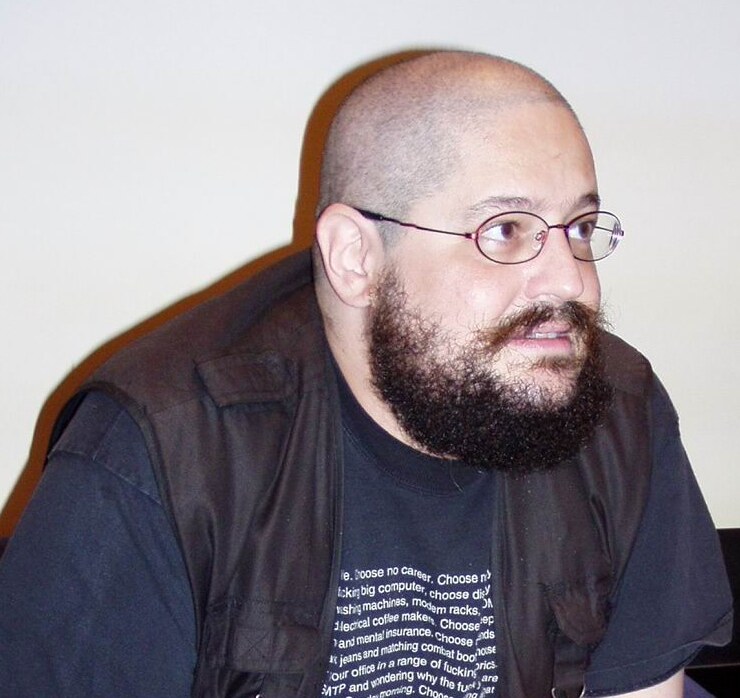
British science fiction writer and blogger
Charles Stross Quotes: 120 Sayings on Love and Success
The 110 most popular of 120 quotes · By the Quotlr.com Team
Charles Stross is a British writer of science fiction and fantasy. He is the author of the popular Merchant Princes series and the Laundry Files series. He has also written several stand-alone novels and short stories. Following is our collection on famous quotes by Charles Stross on love, success, education.
- Born
- October 18, 1964
- Known as
- British Writer
10 quotes
Top 10 Charles Stross Quotes
-
1.
Back before the internet we had a name for people who bought a single copy of our books and lent them to all their friends without charging: we called them "librarians".
-
2.
Idiots emit bogons, causing machinery to malfunction in their presence. System administrators absorb bogons, letting machinery work again.
-
3.
Nothing stands for content-free corporate bullshit quite like PowerPoint. And that's just scratching the surface.
-
4.
More often than not, piracy is a symptom of an under-provisioned market.
-
5.
One ape's hallucination is another ape's religious experience - it just depends on which one’s god module is overactive at the time.
- Advertisement
-
6.
Steampunk is nothing more than what happens when Goths discover brown.
-
7.
The dirty little secret of publishing is that, all along, each book sold has had an average of 5 readers. That's an 80% "piracy" rate if you insist on looking at it in those terms.
-
8.
If an idea is compelling enough it'll stick in my head until I am forced to write it. If it's forgettable, who cares?
-
9.
Any civilization where the main symbol of religious veneration is a tool of execution is a bad place to have children.
-
10.
We're currently living with a generation of established novelists who are embarrassingly out of date with respect to social networking, internet skills, and so on.
10 short quotes
Charles Stross Short Quotes
-
I have not watched the TV show. I do not generally watch TV sci-fi drama shows. They make me itch.
-
I grew up on second hand bookshops and libraries.
-
I wrote two million words of crap. Maybe I'm just a slow learner .
-
I don't like Amazon (wearing my author hat, not my customer hat).
-
Personal pride is probably a bad guide to merit.
-
Writing your own story around the same ideas is not plagiarism; at worst, it's being unoriginal.
-
The trouble is, if you go too far towards being polite, the label that applies is "doormat".
- Advertisement
-
In general, a little controversy isn't harmful: if anything, it gets people interested.
-
I do not click on random youtube videos.
-
I don't do flash fiction.
90 quotes
Charles Stross Famous Quotes And Sayings
-
I suspect losing paper maps but gaining GPS and online maps is a similar step function: maps still exist, but they're vastly more useful, not to say permanently up to date, in their new form. Again, I won't be shedding any tears, but I'll keep a paper road atlas in the back of my car for another few years, I think, Just In Case.
-
Most established novelists are writing books informed by experiences gained in their youth. Middle age is not the best time to be changing smartphones every six months or adopting new technology platforms - because we tend to get slower and less accommodating to change as we age.
-
I'm a fuzzy-headed warm-hearted liberal, and I think fuzzy-headed warm-hearted liberalism is an ideological stance that needs defending-if necessary, with a hob-nailed boot-kick to the bollocks of budding totalitarianism.
-
Personally, I avoid deus ex machina like the plague - if you have to use one, it means you failed to set up the universe and the plot properly. It's like a whodunnit where there's no actual way for the reader to identify the perpetrator before the climactic reveal: there's no sense of closure for the reader.
-
I don't think most of my opinions, political or social, are so far outside of the mainstream that they'd cause massive outrage on a scale liable to provoke death threats or referrals to prosecutors for outraging public decency, so why worry?
-
I'm wearing black leggings and a loose top festooned with a Menger sponge of empty pockets stitched out of smaller pockets and smaller still, almost down to the limits of visibility woven in freefall by hordes of tiny otaku spiders, I'm told, their genes programmed by an obsessive-compulsive sartorial topologist.
-
I've reached an age at which I'd rather pay more for something that "just works" than roll up my sleeves, reach for a spanner, and make it work. Time is money, and the older we get the less of it we've got left.
-
I don't do football. (Grew up in Leeds in the 1970s. Football there was indellibly associated with the National Front, i.e. violent fascist skinheads.)
-
What I read: while I'm writing, I tend to go off reading fiction for relaxation - especially the challenging stuff. It's too much like the day job.
- Advertisement
-
I was an early adopter: have been on the internet continuously since late 1989, barring a six-month loss of access in the early 90s.
-
I'm trapped in a fun-house mirror reflection of a historical society where everyone was crazy by default, driven mad by irrational laws and meaningless customs.
-
Fatal accidents never happen because of just one mistake. It takes a whole chain of stupids lining up just so to put a full stop at the end of an epitaph.
-
Most people think spies are afraid of guns, or KGB guards, or barbed wire, but in point of fact the most dangerous thing they face is paper. Papers carry secrets. Papers carry death warrants. Papers like this one, this folio with its blurry eighteen year old faked missile photographs and estimates of time/survivor curves and pervasive psychosis ratios, can give you nightmares, dragging you awake screaming in the middle of the night.
-
Any replacement to the current copyright position (life plus 70 years) needs to have an answer lined up for this, and similar, messy edge cases.
-
The late 90s were crazy science-fictional if you were inside the superheated steam bubble of the dot-com 1.0 industry.
-
I tend to think that immortal souls, invisible sky daddies, and Santa Claus all belong in the same basket. The disposition of that basket is left as an exercise for the reader.
-
Fiction is about human beings, first and foremost. (It's not impossible to write fiction with no human protagonists, but it's very hard to keep the reader interested ...)
-
I was Computer Shopper's linux columnist for more than half a decade, from the late 90s onwards. Yes, I know about Linux. (My first review of a Linux distro in the press was published in late 1996.)
-
I believe modern SF needs to at least be aware of the singularity, if only so that it can dismiss it intelligently (or work around it). But I suspect the singularity is like faster-than-light travel for the IT generation. We may hope for it, and the rules don't forbid it, but we don't know how to do it yet (and it may not be possible).
-
My gut feeling is that SF as we know it today is actually a heavily propagandized field that grew out of a specific set of cultural trends running in the USA and Europe between 1918 and 1950, during the post-imperial modernization period.
-
What I'm hoping for is something that goes much, much further than the conservative enablers of dog-eat-dog capitalism putting on a puppet show of cleaning house. But that's probably not going to happen just yet.
- Advertisement
-
I like lassic British spy thrillers. Seriously. If the cold war was still on, that's something I'd be writing.
-
I'm an individual. I do not want to get into a pissing match with an organization that is a de-facto gigadollar-turnover multinational!
-
For someone who is starting out on developing their critical skills, just being aware of its existence is great: it can make the difference between trying to write a story around a cliche or an original idea, and better still, studying it can eventually clue you in on how to breathe new life into tired tropes.
-
I have a fear of nuclear annihilation. I'm a child of the cold war: I didn't live more than 10 miles from a major WarPac nuclear target until the Berlin Wall came down and the CW ended. Knowing you can die horribly at any moment because of decisions made by alien intelligences thousands of miles away who don't even know you exist - there's something Lovecraftian about that, isn't there?
-
I'd like to be proven wrong on the difficulty of handling the medical side-effects of long term exposure to deep space (both microgravity induced illnesses and radiation damage).
-
I'd like to be proven wrong firstly on the difficulty of building a self-sustaining closed circuit ecosystem in space that can support human life.
-
I'm told that a couple of my Russian translations are just plain terrible, though, and there may be others.
-
People want to buy mp3s but can't? Piracy ensues. Then Apple strong-arms the music studios into the iTunes store and music piracy drops somewhat. The same, I believe, is also happening with ebooks.
-
What I really think is that our current model of copyright is fundamentally broken. We badly need to replace it with a different system for remunerating creators, which gets it the hell out of the face of the public (who were never aware of it to begin with in the pre-internet dead tree era). Unfortunately, the current copyright model is enshrined in international trade treaty law, making it almost impossible to work around.
-
Today, we see some "file sharing" sites that rely on fans uploading cracked copies of ebooks, and which then make money off those books by charging for downloads (via cash subscriptions or advertising). Again: I take a dim view of this. They're making money off the back of my work without paying me.
-
Back in the pre-internet age there were pirate publishers, especially in the third world, who would print physical copies of books, sell them, and never inform the author/their agent/their publisher just trousering the money. I think we can agree that this was piracy?
-
The problem with ebook filesharing is simply one of scale. But I think the "piracy" problem is massively over-rated.
-
Book depository is nothing new; there've been outlets selling books internationally via mail order for many decades - the only change is that it's now easier to find and use such services.
-
I don't want to permanently damage myself! On the other hand, a couple of days off the keyboard tends to make things somewhat better.
-
If I wanted to be in movies, I'd have gone into scriptwriting: the fact that I write novels should be a big hint about what I prefer to do!
-
While writing a novel I almost completely stop reading books in the same sub-genre for the duration.
-
Writers block: when I get it, it's because my subconscious spotted that I'd make a huge structural mistake in constructing a novel before my conscious mind became aware of it, and threw on the brakes. So I've learned not to sweat it: take two days off, then back up a chapter, read through, and try to work out why I'm suddenly uneasy about continuing.
-
Publishing is the final step in making a book; if I was afraid to publish one, I wouldn't write it in the first place.
-
I have no policy, for or against: only a personal style. Which is to say, I use them when I think it's appropriate to; for example, an internal monologue by a locquacious and verbose narrator is more likely to be larded with adverbs than an exchange of instant messages between cops at a crime scene.
-
If I was a Marxist I'd call it the crisis of capitalism. Even though I'm not a Marxist, that seems like a not unreasonable term for the widening gap between the rich and poor that we're seeing.
-
The one thing that does happen, every time, though, is that I never get to write a book until I've already been thinking about it for a period of months to years.
-
No two books come out the same way. Some I write by the seat of my pants; others are planned in minute detail.
-
Speech recognition is utterly crap for writing fiction. If you try reading a novel aloud you'll soon figure out why - written prose style is utterly unlike the spoken word.
-
If I write too much of anything for too long, I burn out on it. So it helps to vary my output from year to year.
-
Biggest influence: my mother.
-
What I've learned during my life is that the near future is 90% identical to the present - if you buy a new car today, it'll probably still be on the road in 2022.
-
I don't keep anything on paper (except within an actual novel in progress, at which point I need a file to keep track of plot threads, characters, and so on).
-
I reckon I can count on 30 more writing years, averaging a book a year (I can't keep up the 2-2.5 a year I used to do these days). And these days I've gotten round to wondering, for each new idea, "do I want to be remembered for this?" before I get to the point of spending a year on it.
-
My favourite movie is: "Dr Strangelove". (I haven't seen any films released in the past 2-5 years, I'm afraid: I don't do TV/cinema).
-
For a sampler, you could try my short story collection "Wireless". Which contains one novella that scooped a Locus award, and one that won a Hugo, and covers a range of different styles.
-
I'm an atheist .I was raised in British reform Judaism, which is not like American reform Judaism, much less any other strain of organised religion. So: no cults here.
-
When I do get to chow down on a book, I try to read ones that are nothing like what I'm writing. So, as I'm currently working on a space opera (of sorts) I'm mostly indulging in urban fantasy.
-
It's usually quite easy to shrug and write something else instead.
-
I have time to write 1-2 novels per year, and get roughly novel-sized ideas every month. I have to perform triage on my own writing impulses.
-
My agent is based in New York. And due to a historic accident, my publishing track is primarily American - I'm sold into the UK almost as a foreign import! So I'm quite out of touch with what's going on in UK publishing.
-
An important factor to note is that it's rare for anyone to sell a first novel written before they turned 30-35; long-format fiction tends to require a bunch of experience of human life that takes time to acquire. So your average mid-career novelist is in their forties to fifties!
-
I have a CS degree and a history that includes working as a software developer and being a computer magazine columnist back during the 1990s. I guess I simply paid attention to the social effects of the IT revolution as I lived through it.
-
Writing novels takes up about 100% of my available working time.
-
I'm not planning a kickstarter game. And I'm not really a game designer.
-
I was heavily into AD&D in my teens (late 1970s-early 1980s) but fell off the RPG habit in the mid-80s and have never gone back to it; my lifestyle today isn't very compatible with having a regular gaming group (too much travel).
-
I began my first novel when I was 15. It went through three drafts, of around 40,000 words each. If I find it, I'll burn it.
-
I drink tea pretty much continuously at a rate of around 1 imperial pint/hour, which sort of enforces screen/keyboard breaks.
-
I write almost entlirely on Macs, because: Windows gives me hives.
-
I write exclusively using computers. Pens and typewriters can fsck right off - I wrote my first half million words in my teens on a manual typewriter (had to trade it for a new one due to keys snapping from metal fatigue) so I am not a pen or typewriter fetishist.
-
The Magician's Land is a triumphant climax to the best fantasy trilogy of the decade.
-
Life begets intelligence, intelligence begets smart matter and a singularity.
-
The programmers have another saying: 'The question of whether a machine can think is no more interesting than the question of whether a submarine can swim.'
-
We are, after all, homo economicus.
-
Starships are all work and no fun.
-
All men are islands, surrounded by the bottomless oceans of unthinking night.
-
Time is a corrosive fluid, dissolving motivation, destroying novelty, and leaching the joy from life.
-
The chip that functions abnormally will be desoldered, as they say.
-
Had enough of my poetry yet? That's why they pay me to fight demons instead.
-
Where would dictators be without our compliant amnesia? Make the collective lose its memory, you can conceal anything.
-
You know, if I tried to change the minds of everyone who I thought needed changing, I'd never have time to do anything else.
-
Can I remember "I remember lots," I say. How much of what I remember is true is another matter.
-
If I forget, then it might as well never have happened. Memory is liberty.
-
The idea of Curious Yellow, of surrender to a higher cause, seems to appeal to a certain small subset of humanity. These people manipulate the worm, customizing its payload to establish quisling dictatorships in its shadow, and the horrors these gauleiters invent in its service are far worse than the crude but direct tactics the original worm used.
-
A dark-skinned human with four arms walks toward me across the floor of the club, clad only in a belt strung with human skulls.
-
Humans are not as unsophisticated as mulch wrigglers, they can see the writing on the wall. Is it any surprise, that among the ones who look outward, the real debate is not over whether to run, but over how far and how fast?
-
Well then. Will the naysayers please leave the universe?
-
Experiments in digitizing and running neural wetware under emulation are well established; some radical libertarians claim that, as the technology matures, death with its draconian curtailment of property and voting rights will become the biggest civil rights issue of all.
-
You'll still get guys with an array of badges to demonstrate their importance, but that just excludes people. I think fandom is more inclusive now.
-
[Core concepts: Human beings all have souls. Souls are software objects. Software is not immortal.]
-
The real world is devoid of narratives, after all. Narratives are just a thing that our brains do with facts in order to draw a line around the incomprehensible largeness of reality and wrestle it into something learnable and manipulable. Existence is devoid of plot, theme, and most of all moral.
-
A religious college in Cairo is considering issues of nanotechnology: If replicators are used to prepare a copy of a strip of bacon, right down to the molecular level, but without it ever being part of a pig, how is it to be treated?
-
Lawyers do not mix with diplomacy.
-
Humans: such a brilliant model of emotional self-awareness.
-
To boldly go where no uploaded metahuman colony has gone before' has a certain ring to it, doesn't it?
Life Lessons by Charles Stross
- Charles Stross teaches us to think outside the box and explore new possibilities in our writing. He encourages us to take risks and be creative, and to challenge our preconceived notions of what is possible in fiction.
- He also emphasizes the importance of research and incorporating real-world elements into our stories. By doing so, we can create believable and engaging worlds that draw readers in.
- Finally, Charles Stross encourages us to be brave and to write stories that are meaningful and thought-provoking, rather than simply entertaining.
Cite this page · Portrait: CC BY-SA 3.0, via Wikimedia Commons
