
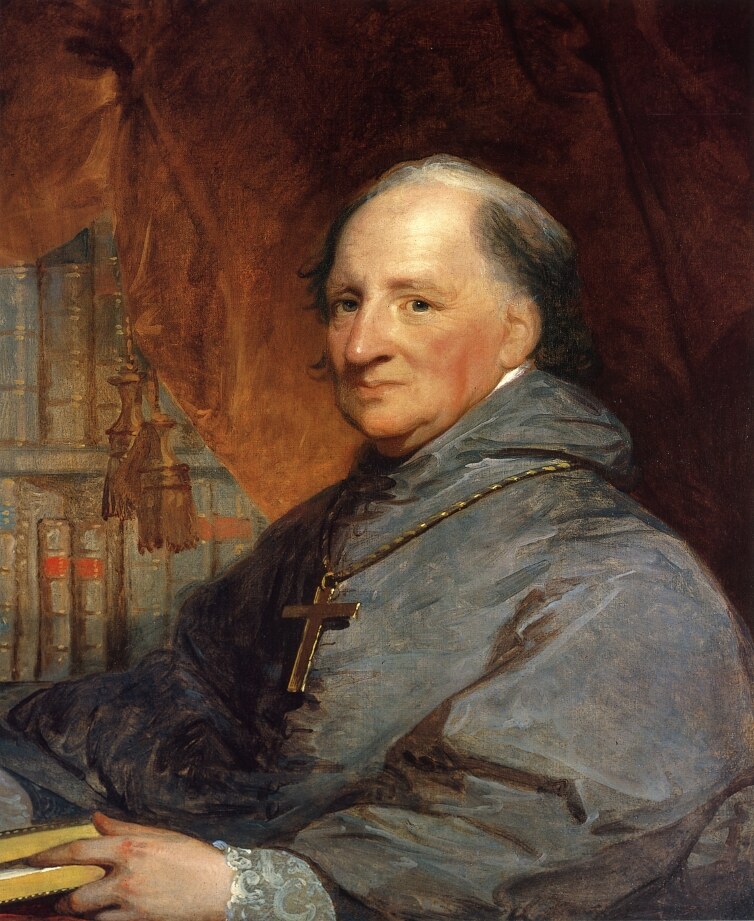
first Roman Catholic bishop and archbishop in the United States
John Carroll Quotes: 37 Sayings on Leadership and Education
By the Quotlr.com Team
The clergy John Carroll was a Jesuit priest, educator, and the first Catholic bishop in the United States. He was also the founder of Georgetown University, the first Catholic university in the United States. He is known for his efforts to promote religious tolerance and the separation of church and state. Following is our collection on famous quotes by John Carroll on leadership, education, life.
- Born
- January 8, 1735
- Died
- December 3, 1815
- Known as
- Clergy
10 quotes
Top 10 John Carroll Quotes
-
1.
The ugliness of the ideological lies in its legitimating the pursuit of the trivial.
-
2.
Nietzsche ... combines, in effect, Christ's harsh sayings: 'let the dead bury their dead' and 'narrow is the way which leadeth unto life'.
-
3.
In so far as the intention of education is to train the child for a vocation it is a millstone around his neck.
-
4.
Man at his best is a system-breaker, an iconoclast seeking not only variety, but destruction.
-
5.
For Dostoevsky, Fourier is one of the industrious ant-hill engineers, busy, protected by the delusion that his goal, the will-ordered society, is the summation of all his desires.
- Advertisement
-
6.
This will of Stirner's, this restless probing of all given knowledge, this endless questioning, and the continuous bending towards new understanding.
-
7.
Politics and the affairs of State are dissociated from the orbit of the individual, and in so far as they cannot be repossessed as his living private property they must be rendered impotent.
-
8.
Education is the strongest weapon available for restricting the questions people ask, controlling what they think, and ensuring that they get their thoughts 'from above'.
-
9.
Men become utilitarian out of fear of the alternative the chaos of tangled or tepid desires, of rootlessness and boredom.
-
10.
A teleology directed to material ends has been substituted for the lust for adventure, variety, and play.
27 quotes
John Carroll Famous Quotes And Sayings
-
There is a strain in Marx of the cleric, of the vulgar moralist. He paints the capitalist and the bourgeois as incarnations of evil; it is they who are responsible for the woes of mankind. The dismissal of the individual's responsibility for his own misery is the quintessence of clericalism.
-
The garden [of Eden] is the realm of pure beauty from which man is expelled when he becomes interested in ethics, in the fruit of the tree of knowledge of good and evil. The return into paradise, the homecoming, depends on him penetrating the veils of morality to glimpse again the lineaments of lost beauty.
-
The virtual suppression of ethical discussion after 1845 produces the semblance of purely descriptive analysis, dressed in the mantle of positivist objectivity, analysis which is, in fact, strung to a framework of crude, because unexplicated, moral assumptions.
-
Ownership of thought depends on the thinker not subordinating himself to a 'ruling thought'. This is particularly difficult, argues Stirner, ... for language itself is a network of 'fixed ideas'. Truths emerge only when language is reworked and possessed individually.
-
The act of greatest subversion ... is the one of indifference. A man, or a group, finds it unbearable that someone can be simply uninterested in his, or its, convictions. ... There is a degree of complicity, or mutual respect, between the believer and the man who attacks his beliefs (the revolutionary), for the latter takes them seriously.
-
Utilitarianism had found [in Samuel Smiles' Self-Help] its portrait gallery of heroes, inscribed with a vigorous exhortation to all men to strive in their image; this philistine romanticism established the bourgeois hero-prototype the penniless office-boy who works his way to economic fortune and this wins his way into the mercantile plutocracy.
-
Dostoevsky believed that the gods of rationalism and materialist utilitarianism had joined in conspiracy against all other ethical systems. ... The accumulation of capital, or the acquisition of money, are endeavors par excellence which establish a quantifiable goal: hence they are directly amenable to maximization formulae.
- Advertisement
-
Any attempt to break with the past, or with existing social structures, is a failure if it leads to a bored, listless, and colourless style of life; assertive and enduring innovation, like the mastering of a new environment, requires the confidence and discipline which are founded on exuberant emotions.
-
Stirner's political praxis is quixotic. It accepts the established hierarchies of constraint as given. ... Not liable to any radical change, they constitute part of the theatre housing the individual's action. ... The egoist uses the elements of the social structure as props in his self-expressive act.
-
The egoist ... destroys the universal importance accorded to moral law by showing that life independent of it is possible. Secondly, and even more intolerably to the pious, he manages to do so with shameless enjoyment.
-
Nietzsche ... argues that all that passes in the life of a society is ephemeral and banausic except for the presence of great personalities, of men like Goethe ... who seem to forge their own destinies, who seem to move unhampered by those burdens of existence which keep most men from rising above the vicissitudes of their daily toil.
-
The dialectical critique of positivist habits of mind ... is interested only in behaviour which is 'important' to the actor; that is, behaviour which is emotionally charged to the degree that it is either frequently recalled, reflected upon, or day-dreamed about. ... That science which is less discriminating in the behaviour it chooses to investigate gains clarity and distinctiveness at the cost of confining itself to the trivial.
-
If man is to remain the creator and master of his world then, Stirner maintains, ... all that has been accepted, that has taken on the secure guise of the 'fact', must be return to a state of flux, or be rejected.
-
For Stirner, the social axiom of conservative, liberal, and socialist schools of political thought alike is in itself repressive: it disguises as potentially redemptive an order whose central function is inhibitory of the individual's interests.
-
The attachment to a rationalistic, teleological notion of progress indicates the absence of true progress; he whose life does not unfold satisfyingly under its own momentum is driven to moralize it, to set up goals and rationalize their achievement as progress.
-
What stands most explicitly as critique in Nietzsche's late work in not a development from earlier interests but a return to two problems of enduring personal involvement for him, those of Wagner and of Christianity. Der Antichrist , to take one case, is not a response to a resuscitating public interest in Christian religion; it is primarily a renewed attempt to resolve for himself the question of piety.
-
Unlike Hegel's progress model of history, which moves by stages, each containing its own logic of growth and decline, the economic model develops as the simple function of one money-variable over time, with a long-term trend which increases monotonically.
-
Dostoevsky's underground man ... observes his contemporaries striving to establish false goals where there are no naturally generated ones. ... He argues they should be conscious and honest enough to recognize that the goal itself is not an absolute, and probably not even important. A strong attachment to the telos indicates that the spontaneous enjoyment the child once took in road-building has waned.
-
Life is more than thought: what a man feels, and what his senses awaken in him, are more indispensable to his life's fullness than subsequent reflection on their significance. Both Stirner and Nietzsche have elaborated Faust's opening speech in which he bemoans his wasted years in academia: this speech is Goethe's own impeachment of Kant and Hegel . Philosophy proceeds always under the risk of making a fetish of thinking.
- Advertisement
-
The primary ambition of Nietzsche's critique of knowledge is ... to demonstrate that 'truths' are fictions masking moral commitments.
-
Nietzsche saw in the Protestant ethic, in both its religious and secular (economic) forms, a final protest before the emergence into dominance of the ordered, bourgeois world of the 'last man' he who will pay any price in tedium for comfort and the absence of tension.
-
Man is more than an animal only in that he finds expression for the beautiful.
-
The original of morals lies with the thought that 'the community is more valuable than the individual' (Menschliches 2.1.89
-
The enemies of Christ ... could not bear his independence; his "Give the emperor that which is the emperor's" showed a contempt for the affairs of state and its politics for the moral order that their self-respect would not let them tolerate.
-
Nietzsche himself was a great moralist; his writings abound with value judgments about individuals, character types, modes of thinking, and national traits. It is as if he develops immoralist psychology in order to tame his own nature, to keep his own greatest vice in check.
-
Stirner and Nietzsche ... reveal how prone morality is to being used as a means of rationalization, a cloak for concealing violent and brutish passions, and making their sadistic expression a virtue.
-
[Marx] explicates ideology as socially determined, [Stirner] as psychologically determined: both accuse it of remaining oblivious to its own determinations.
Life Lessons by John Carroll
- John Carroll's work as a clergyman serves as an example of how one person can make a difference in the world through their faith. He was a leader in the American Revolution and worked to ensure that religious freedom was secured for all citizens.
- Through his work, John Carroll demonstrated the importance of standing up for what is right and working to create a better future for all. He was a strong advocate for religious freedom and worked to ensure that all people were treated with respect and dignity.
- John Carroll's legacy serves as a reminder that everyone can make a difference in the world, no matter their faith or background. His work serves as an inspiration to stand up for what is right and work to create a better future for all.
Cite this page · Portrait: Gilbert Stuart, Public domain, via Wikimedia Commons
