
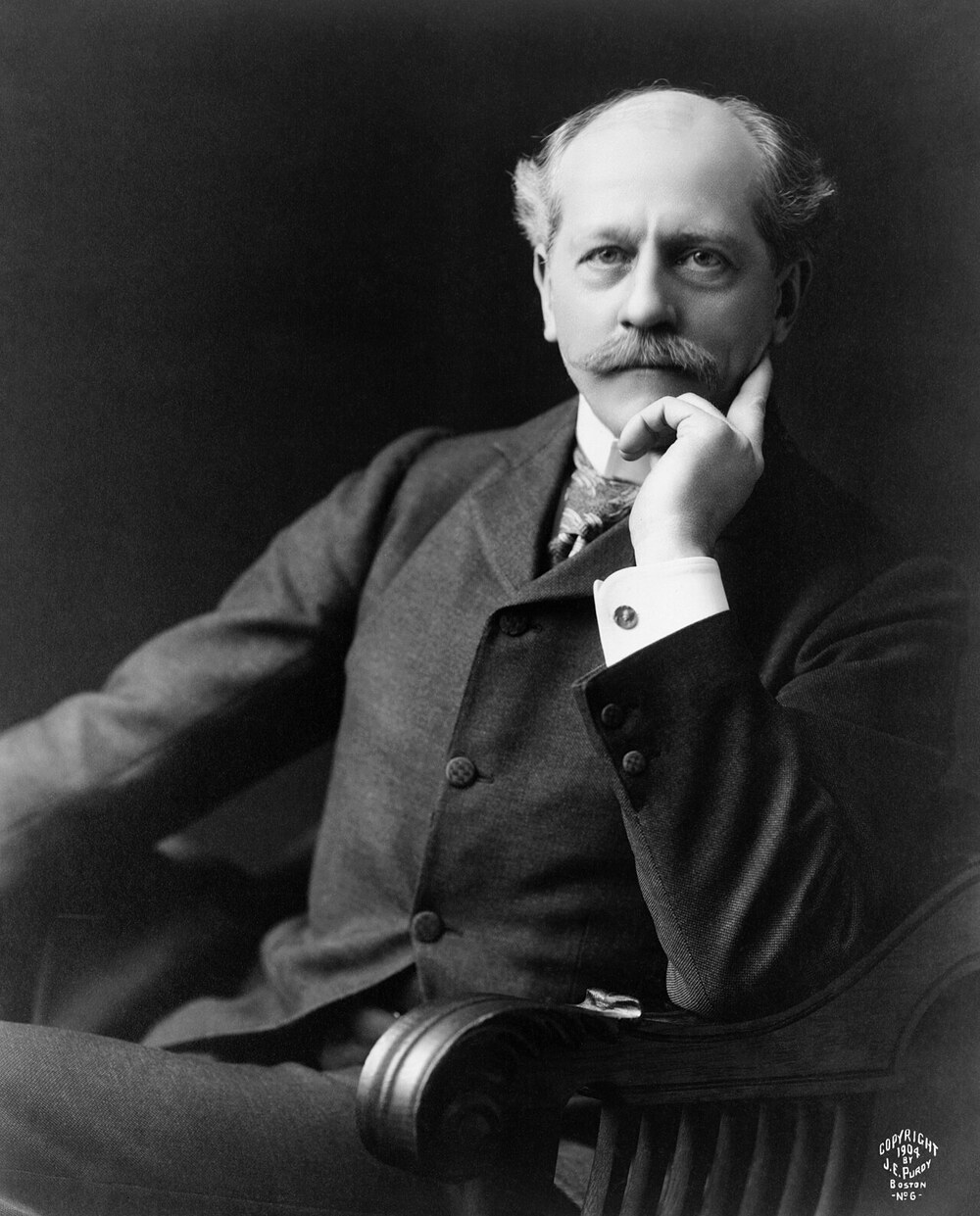
American astronomer
Percival Lowell Quotes: 13 Sayings on Nature and Knowledge
By the Quotlr.com Team
Percival Lowell was an American author, mathematician, and astronomer who founded the Lowell Observatory in Flagstaff, Arizona. He is best known for his research on the planet Mars and his popular books on the subject, including Mars (1895) and Mars and Its Canals (1906). Lowell also wrote extensively on the Orient and the Far East, publishing books such as Occult Japan (1895) and Noto: An Unexplored Corner of Japan (1905). Following is our collection on famous quotes by Percival Lowell on nature, knowledge, freedom.
- Born
- March 13, 1855
- Died
- November 12, 1916
- Known as
- American Author
-
Imagination is as vital to any advance in science as learning and precision are essential for starting points.
-
That Mars is inhabited by beings of some sort or other we may consider as certain as it is uncertain what these beings may be.
-
Bright points in the sky or a blow on the head will equally cause one to see stars.
-
Formulae are the anaesthetics of thought, not its stimulants and to make any one think is far better worth while than cramming him with ill-considered, and therefore indigestible, learning.
-
Are physical forces alone at work there, or has evolution begotten something more complex, something not akin to what we know on Earth as life? It is in this that lies the peculiar interest of Mars.
- Advertisement
-
War is a survival among us from savage times and affects now chiefly the boyish and unthinking element of the nation.
-
Now when we think that each of these stars is probably the centre of a solar system grander than our own, we cannot seriously take ourselves to be the only minds in it all.
-
Imagination is as vital to any advance in science as learning and precision are essential for starting points. Let me warn you to beware of two opposite errors: of letting your imagination soar unballasted by facts, but on the other hand, of shackling it so solidly that it loses all incentive to rise.
-
Ever since celestial mechanics in the skillful hands of Leverrier and Adams led to the world-amazed discovery of Neptune, a belief has existed begotten of that success that still other planets lay beyond, only waiting to be found.
-
The whole object of science is to synthesize, and so simplify; and did we but know the uttermost of a subject we could make it singularly clear.
-
There are celestial sights more dazzling, spectacles that inspire more awe, but to the thoughtful observer who is privileged to see them well, there is nothing in the sky so profoundly impressive as the canals of Mars. Fine lines and little gossamer filaments only, cobwebbing the face of the Martian disk, but threads to draw one's mind after them across the millions of miles of intervening void.
-
Irrigation, unscientifically conducted, would not give us such truly wonderful mathematical fitness [as we observe in the Martian canals]. . . . A mind of no mean order would seem to have presided over the system we see-a mind certainly of considerably more comprehensiveness than that which presides over the various department of our own public works.
-
If astronomy teaches anything, it teaches that man is but a detail in the evolution of the universe, and the resemblant though diverse details are inevitably to be expected in the hosts of orbs around him. He learns that, though he will probably never find his double anywhere, he is destined to discover any number of cousins scattered through space.
Life Lessons by Percival Lowell
- Percival Lowell's work emphasizes the importance of curiosity and exploration in understanding the world around us. He was a passionate astronomer who dedicated his life to studying the universe and uncovering its mysteries.
- His work also highlights the power of imagination, as he was able to use his observations to create theories about the existence of life on Mars.
- Lowell's work serves as an example of how dedication and hard work can lead to incredible discoveries, and how the pursuit of knowledge can help us better understand the universe.
Cite this page · Portrait: James E. Purdy / Adam Cuerden, Public domain, via Wikimedia Commons
