
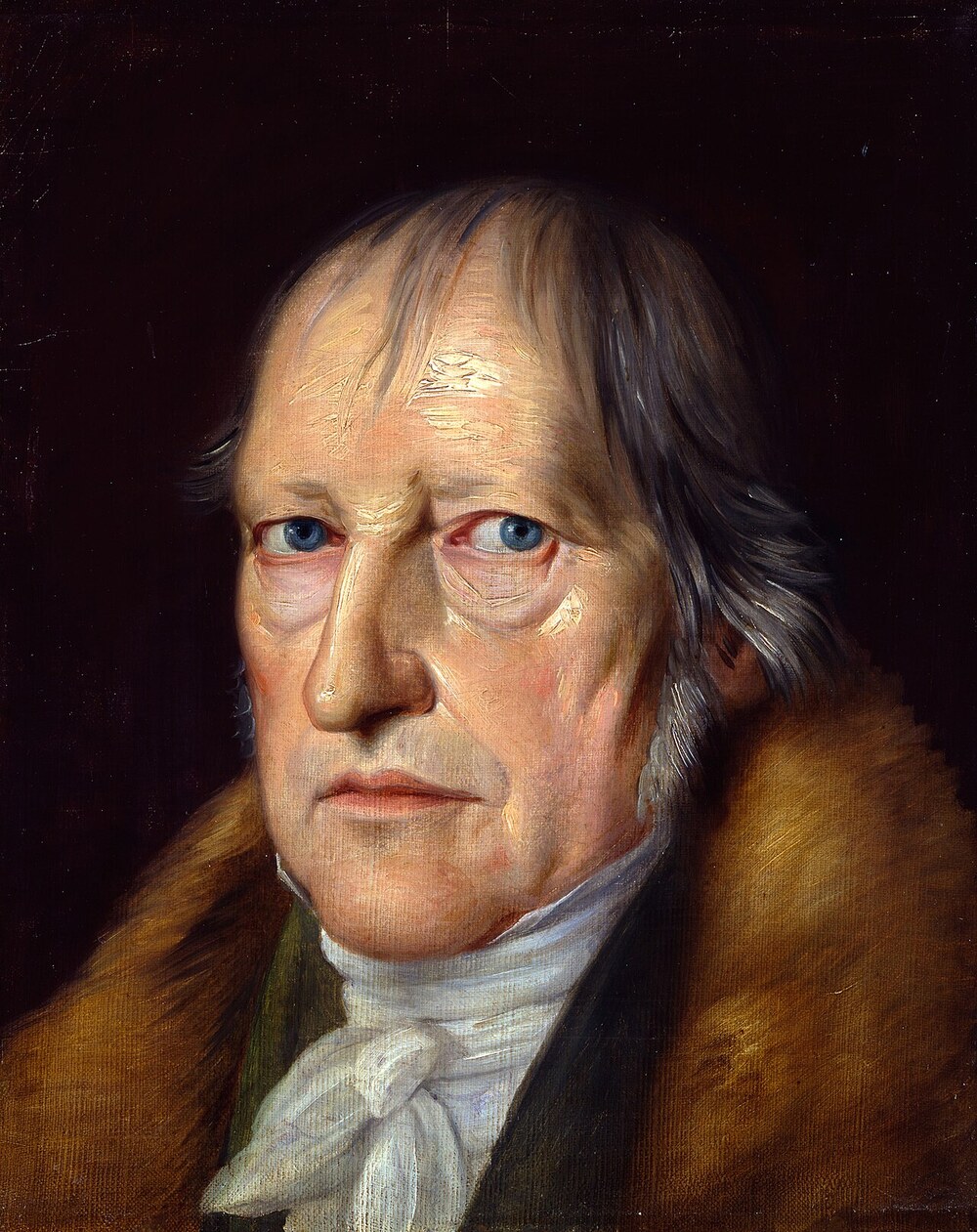
German Philosopher
110+ Georg Wilhelm Friedrich Hegel Quotes On Religion, Education And World
Updated: by Quotlr.com Team
Georg Wilhelm Friedrich Hegel was a German philosopher who developed a comprehensive philosophical framework, or "system," to explain the nature of reality. He is best known for his dialectic method of arriving at the truth by reconciling opposing positions and synthesizing them into a higher truth. His work had a major influence on subsequent philosophical development in the 19th and 20th centuries. Following is our collection on famous quotes by Georg Wilhelm Friedrich Hegel on religion, education, love.
- Died
- November 14, 1831
- Known as
- German Philosopher
Top 10 Georg Wilhelm Friedrich Hegel Quotes
-
1.
We learn from history that we do not learn from history
-
2.
Truth is found neither in the thesis nor the antithesis, but in an emergent synthesis which reconciles the two.
-
3.
Genuine tragedies in the world are not conflicts between right and wrong. They are conflicts between two rights.
-
4.
Every idea, extended into infinity, becomes its own opposite.
-
5.
The History of the world is not the theatre of happiness. Periods of happiness are blank pages in it, for they are periods of harmony--periods when the antithesis is in abeyance.
- Advertisement
-
6.
No man is a hero to his valet. This is not because the hero is no hero, but because the valet is a valet.
-
7.
War is progress, peace is stagnation.
-
8.
The owl of Minerva spreads its wings only with the falling of the dusk.
-
9.
Reading the morning newspaper is the realist's morning prayer.
-
10.
Philosophy is by its nature something esoteric, neither made for the mob nor capable of being prepared for the mob.
Georg Wilhelm Friedrich Hegel Short Quotes
-
The valor that struggles is better than the weakness that endures.
-
Only one man ever understood me, and he didn't understand me
-
To make abstractions hold in reality is to destroy reality.
-
Whatever is reasonable is true, and whatever is true is reasonable
-
Destiny is consciousness of oneself, but consciousness of oneself as an enemy.
-
What is rational is actual and what is actual is rational
-
God is, as it were, the sewer into which all contradictions flow.
- Advertisement
-
No man is a hero to his valet de chamber
-
I have the courage to be mistaken.
-
An individual piece only has meaning when it is seen as part of the whole.
Georg Wilhelm Friedrich Hegel Quotes About Love
-
Propounding peace and love without practical or institutional engagement is delusion, not virtue.
-
If you want to love you must serve, if you want freedom you must die.
-
A man who has work that suits him and a wife, whom he loves, has squared his accounts with life.
-
Too fair to worship, too divine to love.
Georg Wilhelm Friedrich Hegel Quotes About World
-
America is therefore the land of the future, where, in the ages that lie before us, the burden of the World's History shall reveal itself.
-
The history of the world is none other than the progress of the , consciousness of freedom.
-
The East knew and to the present day knows only that One is Free; the Greek and the Roman world, that some are free; the German World knows that All are free. The first political form therefore which we observe in History, is Despotism, the second Democracy and Aristocracy, the third, Monarchy.
-
Nothing great in the world was accomplished without passion.
-
India has created a special momentum in world history as a country to be searched for knowledge.
- Advertisement
-
Whatever happens, every individual is a child of his time; so philosophy too is its own time apprehended in thoughts. It is just as absurd to fancy that a philosophy can transcend its contemporary world as it is to fancy that an individual can overleap his own age, jump over Rhodes.
-
When Philosophy with its abstractions paints grey in grey, the freshness and life of youth has gone, the reconciliation is not a reconciliation in the actual, but in the ideal world.
-
To him who looks at the world rationally the world looks rationally back.
-
Reading the morning newspaper is the realist's morning . One orients one's attitude toward the either by or by what the world is. The former gives as much security as the latter, in that one knows how one stands.
-
As high as mind stands above nature, so high does the state stand above physical life. Man must therefore venerate the state as a secular deity.
Georg Wilhelm Friedrich Hegel Quotes About History
-
We learn from history that man can never learn anything from history.
-
Regarding History as the slaughter-bench at which the happiness of peoples, the wisdom of States, and the virtue of individuals have been victimized--the question involuntarily arises--to what principle, to what final aim these enormous sacrifices have been offered.
-
History is not the soil of happiness. The periods of happiness are blank pages in it.
-
Philosophy is the history of philosophy.
-
Governments have never learned anything from history, or acted on principles deducted from it.
-
Before the end of Time will be the end of History. Before the end of History will be the end of Art.
-
What history teaches us is that neither nations nor governments ever learn anything from it.
- Advertisement
-
History teaches us that man learns nothing from history
-
History as the slaughter-bench
-
In history, we are concerned with what has been and what is; in philosophy, however, we are concerned not with what belongs exclusively to the past or to the future, but with that which is, both now and eternally in short, with reason.
Georg Wilhelm Friedrich Hegel Quotes About Absolute
-
The State is the absolute reality and the individual himself has objective existence, truth and morality only in his capacity as a member of the State.
-
The beginning of religion, more precisely its content, is the concept of religion itself, that God is the absolute truth, the truth of all things, and subjectively that religion alone is the absolutely true knoweldge.
-
God is the absolute truth...
Georg Wilhelm Friedrich Hegel Famous Quotes And Sayings
-
It is solely by risking life that freedom is obtained; . . . the individual who has not staked his or her life may, no doubt, be recognized as a Person; but he or she has not attained the truth of this recognition as an independent self-consciousness.
-
The true courage of civilized nations is readiness for sacrifice in the service of the state, so that the individual counts as only one amongst many. The important thing here is not personal mettle but aligning oneself with the universal.
-
What the English call "comfortable" is something endless and inexhaustible. Every condition of comfort reveals in turn its discomfort, and these discoveries go on for ever. Hence the new want is not so much a want of those who have it directly, but is created by those who hope to make profit from it.
-
Genuine tragedy is a case not of right against wrong but of right against right - two equally justified ethical principles embodied in people of unchangeable will.
-
Not curiosity, not vanity, not the consideration of expediency, not duty and conscientiousness, but an unquenchable, unhappy thirst that brooks no compromise leads us to truth.
-
Freedom is the fundamental character of the will, as weight is of matter... That which is free is the will. Will without freedom is an empty word.
-
It is because the method of physics does not satisfy the comprehension that we have to go on further.
-
People who are too fastidious towards the finite never reach actuality, but linger in abstraction, and their light dies away.
-
The proofs of the existence of God are to such an extent fallen into discredit that they pass for something antiquated, belonging to days gone by.
-
Poetry is the universal art of the spirit which has become free in itself and which is not tied down for its realization to external sensuous material; instead, it launches out exclusively in the inner space and the inner time of ideas and feelings.
-
In the case of various kinds of knowledge, we find that what in former days occupied the energies of men of mature mental ability sinks to the level of information, exercises, and even pastimes for children; and in this educational progress we can see the history of the world's culture delineated in faint outline.
-
Since philosophy is the exploration of the rational, it is for that very reason the apprehension of the present and the actual, not the erection of a beyond, supposed to exist, God knows where, or rather which exists, and we can perfectly well say where, namely in the error of a one-sided, empty, ratiocination.
-
To be independent of public opinion is the first formal condition of achieving anything great or rational whether in life or in science. Great achievement is assured, however, of subsequent recognition and grateful acceptance by public opinion, which in due course will make it one of its own prejudices
-
Poverty in itself does not make men into a rabble; a rabble is created only when there is joined to poverty a disposition of mind, an inner indignation against the rich, against society, against the government.
-
The nature of finite things is to have the seed of their passing-away as their essential being: the hour of their birth is the hour of their death.
-
When individuals and nations have once got in their heads the abstract concept of full-blown liberty, there is nothing like it in its uncontrollable strength.
-
...if the fear of falling into error is the source of a mistrust in Science, which in the absence of any such misgivings gets on with the work itself and actually does know, it is difficult to see why, conversely, a mistrust should not be placed in this mistrust, and why we should not be concerned that this fear of erring is itself the very error.
-
Consequently, the sensuous aspect of art is related only to the two theoretical sensesof sight and hearing, while smell, taste, and touch remain excluded.
-
The sole work and deed of universal freedom is therefore death, a death too which has no inner significance or filling, for what is negated is the empty point of the absolutely free self. It is thus the coldest and meanest of all deaths, with no more significance than cutting off a head of cabbage or swallowing a mouthful of water.
-
The sublime in art is the attempt to express the infinite without finding in the realm of phenomena any object which proves itself fitting for this representation.
-
It is a matter of perfect indifference where a thing originated; the only question is: Is it true in and for itself?
-
Education to independence demands that young people should be accustomed early to consult their own sense of propriety and their own reason. To regard study as mere receptivity and memory work is to have a most incomplete view of what instruction means.
-
The bud disappears when the blossom breaks through, and we might say that the former is refuted by the latter; in the same way when the fruit comes, the blossom may be explained to be a false form of the plant's existence, for the fruit appears as its true nature in place of the blossom.
-
When needs and means become abstract in quality, abstraction is also a character of the reciprocal relation of individuals to oneanother. This abstract character, universality, is the character of being recognized and is the moment which makes concrete, i.e. social, the isolated and abstract needs and their ways and means of satisfaction.
-
The evident character of this defective cognition of which mathematics is proud, and on which it plumes itself before philosophy, rests solely on the poverty of its purpose and the defectiveness of its stuff, and is therefore of a kind that philosophy must spurn
-
Beauty and art pervade all the business of life like a kindly genius, brightly adorning our surroundings whether interior or exterior, mitigating the seriousness of existence and the complexities of the real life, extinguishing idleness in an entertaining fashion, and, where there is nothing good to be achieved, filling the place of vice better than vice itself.
-
The real is the rational and the rational is the real.
-
It strikes everyone in beginning to form an acquaintance with the treasures of Indian literature that a land so rich in intellectual products and those of the profoundest order of thought.
-
The more certain our knowledge the less we know.
-
The State is the Divine idea as it exists on Earth.
-
Beauty is merely the Spiritual making itself known sensuously.
-
The heart-throb for the welfare of humanity therefore passes into the ravings of an insane self-conceit, into the fury of consciousness to preserve itself from destruction; and it does this by expelling from itself the perversion which it is itself, and by striving to look on it and express it as something else.
-
Nothing great has been and nothing great can be accomplished without passion. It is only a dead, too often, indeed, a hypocriticalmoralizing which inveighs against the form of passion as such.
-
What is rational is actual and what is actual is rational. On this conviction the plain man like the philosopher takes his stand,and from it philosophy starts in its study of the universe of mind as well as the universe of nature.
-
The True is the whole. But the whole is nothing other than the essence consummating itself through its development. Of the Absolute it must be said that it is essentially a result, that only in the end is it what it truly is; and that precisely in this consists its nature, viz. to be actual, subject, the spontaneous becoming of itself.
-
Children are potentially free and their life directly embodies nothing save potential freedom. Consequently they are not things and cannot be the property either of their parents or others.
-
We must have a new mythology, but it must place itself at the service of ideas, it must become a mythology of reason. Mythology must become philosophical, so that the people may become rational, and philosophy must become mythological, so that philosophers may become sensible. If we do not give ideas a form that is aesthetic, i.e., mythological, they will hold no interest for people.
-
There are Plebes in all classes.
-
Every philosophy is complete in itself and, like a genuine work of art, contains the totality. Just as the works of Apelles and Sophocles, if Raphael and Shakespeare had known them, should not have appeared to them as mere preliminary exercises for their own work, but rather as a kindred force of the spirit, so, too reason cannot find in its own earlier forms mere useful preliminary exercises for itself.
-
The essence of the modern state is the union of the universal with the full freedom of the particular, and with the welfare of individuals.
-
The man whom philosophy leaves cold, and the man whom real faith does not illuminate, may be assured that the fault lies in them, not in knowledge and faith. The former is still an alien to philosophy, the latter an alien to faith.
-
Impatience asks for the impossible, wants to reach the goal without the means of getting there. The length of the journey has to be borne with, for every moment is necessary.
-
In the Soul is the awaking of Consciousness: Consciousness sets itself up as Reason, awaking at one bound to the sense of its rationality: and this Reason by its activity emancipates itself to objectivity and the consciousness of its intelligent unity.
-
The true is the whole.
-
What is reasonable is real; that which is real is reasonable.
-
The soul is presupposed as a ready-made agent, which displays such features as its acts and utterances, from which we can learn what it is, what sort of faculties and powers it possesses -- all without being aware that the act and utterance of what the soul is really invests it with that character in our conception and makes it reach a higher stage of being than it explicitly had before.
-
Philosophy must indeed recognize the possibility that the people rise to it, but must not lower itself to the people.
-
The force of mind is only as great as its expression; its depth only as deep as its power to expand and lose itself.
-
The life of God - the life which the mind apprehends and enjoys as it rises to the absolute unity of all things - may be described as a play of love with itself; but this idea sinks to an edifying truism, or even to a platitude, when it does not embrace in it the earnestness, the pain, the patience, and labor, involved in the negative aspect of things.
-
In a true tragedy, both parties must be right.
-
Reason is just as cunning as she is powerful. Her cunning consists principally in her mediating activity, which, by causing objects to act and re-act on each other in accordance with their own nature, in this way, without any direct interference in the process, carries out reason's intentions.
-
The courage of the truth is the first condition of philosophic study.
-
In history an additional result is commonly produced by human actions beyond that which they aim at and obtain -- that which they immediately recognize and desire. They gratify their own interest; but something further is thereby accomplished, latent in the actions in question, though not present to their consciousness, and not included in their design.
-
When we walk the streets at night in safety, it does not strike us that this might be otherwise. This habit of feeling safe has become second nature, and we do not reflect on just how this is due solely to the working of special institutions. Commonplace thinking often has the impression that force holds the state together, but in fact its only bond is the fundamental sense of order which everybody possesses.
-
Evil resides in the very gaze which perceives Evil all around itself.
-
On the stage on which we are observing it, — Universal History — Spirit displays itself in its most concrete reality.
-
Science and knowledge, especially that of philosophy, came from the Arabs into the West.
-
We assert then that nothing has been accomplished without interest on the part of the actors; and — if interest be called passion, inasmuch as the whole individuality, to the neglect of all other actual or possible interests and claims, is devoted to an object with every fibre of volition, concentrating all its desires and powers upon it — we may affirm absolutely that nothing great in the World has been accomplished without passion.
-
The person must give himself an external sphere of freedom in order to have being as Idea.
-
Serious occupation is labor that has reference to some want.
-
The Catholics had been in the position of oppressors, and the Protestants of the oppressed
-
To be aware of limitations is already to be beyond them.
-
The substance, the essence, the Spirit is freedom.
-
The heart is everywhere, and each part of the organism is only the specialized force of the heart itself.
-
The first glance at History convinces us that the actions of men proceed from their needs, their passions, their characters and talents; and impresses us with the belief that such needs, passions and interests are the sole spring of actions.
-
The essence of the modern state is that the universal be bound up with the complete freedom of its particular members and with private well-being, that thus the interests of family and civil society must concentrate themselves on the state. It is only when both these moments subsist in their strength that the state can be regarded as articulated and genuinely organized.
-
Africa has no history and did not contribute to anything that mankind enjoyed.
Life Lessons by Georg Wilhelm Friedrich Hegel
- Hegel's philosophy emphasizes the importance of understanding the dialectical process of thesis, antithesis, and synthesis in order to gain a more complete understanding of the world.
- He also believed that the truth lies in the whole, rather than in individual parts, and that one must strive for the synthesis of opposing ideas in order to gain a more comprehensive understanding.
- Hegel's work emphasizes the importance of finding balance between opposing forces and understanding the interconnectedness of all things in order to gain a more holistic understanding of reality.
Cite this page · Portrait: Jakob Schlesinger, Public domain, via Wikimedia Commons
